
Globalisation and technology are bringing the world closer together, which means lawyers need to be equipped with both legal and non-legal skills to get cross-border business deals done.

In our globalised world, important commercial transactions often take place across multiple countries. The unrelenting pace of technological innovation will amplify the opportunities for such cross-border deals. To stay relevant, legal professionals must be comfortable with this new reality, which means understanding the underlying business and technological considerations as well as the legal rules that apply to cross-border deals.
The practice of law is set to become ever more challenging. The world is increasingly interconnected and technological development is a key catalyst in accelerating this evolution. Consequently, the number of cross-border transactions that require legal fluency in multiple sets of laws is certain to grow exponentially. To thrive in this dynamic and fast-paced environment, legal professionals will need to be well-versed in cross-border business and finance law.
As global economic power shifts eastward, Asian nations are working to deepen regional economic integration through multilateral endeavours such as the ASEAN Economic Community, the Comprehensive and Progressive Agreement for Trans-Pacific Partnership, and China’s Belt and Road Initiative. Legal and business communities, too, are pushing for the increased convergence of Asian commercial laws, as this would reduce the uncertainties, delays and costs caused by inconsistencies between different legal regimes.
However, bringing national business laws in this diverse region closer together is not without obstacles, said Professor Tang Hang Wu, Academic Director of the Centre for Cross-Border Commercial Law in Asia (now known as Centre for Commercial Law in Asia), Singapore Management University (SMU). He is also a consultant and co-head of the Trusts and Private Wealth Practice at TSMP Law Corporation.
Prof Tang explained: “Asia is not a monolith — it comprises different countries with myriad languages, legal cultures and stages of development. Secondly, in some countries there may exist a formal and semi-formal way of doing things. Thus, the law in the books may be very different from the law in practice. Finally, it is often difficult to find the political will from the leaders of many countries to agree to converge their business laws.”
Successful transnational commercial lawyers, said Prof Tang, are therefore “amphibians” — that is, they can thrive in different environments with ease. “A successful lawyer must be skilled not just in the law but in the cultural context, and be able to bridge the differences between the parties and conclude a successful contract or settle a dispute which may have arisen between the parties.”
Technology, too, has vastly altered the legal profession. Among the topical problems that lawyers face are the commercialisation of intellectual property and the protection of personal data across state borders. Business lawyers and in-house counsels alike will thus have to upgrade their knowledge to understand the requirements imposed by other Asian and leading Western legal systems, as well as continuously track the myriad changes to Singapore law that affect technology and its use.
“All businesses need to be acutely aware of the need to safeguard and control the use of personal data under the local laws of any country, either in which it is used in any way or to which it is transferred,” said SMU’s Professor David Llewelyn who has been practising and teaching intellectual property law for many years in the United Kingdom and, more recently, in Singapore.
GO WHERE THE HUB IS
To overcome costly or difficult cross-border externalities, many businesses increasingly choose to have their contracts governed by the laws of countries that are well-regarded as transparent, neutral and pro-business. Cue Singapore, with its top-notch judiciary and its clean and incorrupt system. Indeed, the Singapore government is firmly committed to positioning the country as Asia’s foremost regional legal hub.
For example, the Singapore International Commercial Court (SICC), Singapore International Arbitration Centre (SIAC) and Singapore International Mediation Centre (SIMC) offer a comprehensive suite of options for businesses to resolve cross-border disputes. This infrastructure also makes it attractive for companies to adopt the use of Singapore law in their commercial dealings, even if they are located or primarily do business in other countries.
The result is a growing demand for lawyers and in-house counsels who are well-versed in Singapore and key transnational rules. Those with relevant non-legal skills, such as an understanding of the underlying business processes of the industries they are dealing with, are even more sought after. “Lawyers with good analytical skills, the ability to think laterally and ‘out-of-the-box’, and cross-cultural sensitivity are seeing an increasing demand for their services,” observed Prof Llewelyn.
In his Opening of the Legal Year 2020 speech, Chief Justice Sundaresh Menon offered insight into the desired attributes that the lawyers of tomorrow should possess: “The constant churn of knowledge in an ever-evolving world demands a responsive and dynamic system of continuing education that targets the profession’s most pressing needs, efficiently imparts new skills, and engages the profession’s interest and attention.”
Pathways should also be created for mid-career individuals with non-law backgrounds to enter the profession, added Chief Justice Menon. “This will encourage individuals with complementary backgrounds and skillsets — such as in computer science or STEM [science, technology, engineering and mathematics]-related fields — to join and so strengthen our legal services sector.”
SMU offers a Master of Laws (LLM) programme, an advanced law degree which has ‘Cross-Border Business and Finance Law in Asia’ as one of its three tracks. All LLM students are required to take courses on law and technology, mediation and commercial obligations. For more information, click here.
SMU also offers a Juris Doctor (JD) programme, a qualifying law degree for professionals who have prior experience and expertise in other disciplines and who wish to leverage that knowledge to enhance Singapore’s legal profession. For more information, click here.
This article was reproduced with permission from channelnewsasia.com (March 6, 2020) www.cna.asia/smumasters-law

Law, as a profession or a discipline, has always been in constant flux as it evolves with the ebbs and flows of human development in societies - and the legal landscape right now is no exception.
Beyond the explosive e-commerce boom seen during the height of the Covid-19, the pandemic has pushed technological transformation over the tipping point and permanently disrupted the way we do business. The rapid rise of digital transactions, fintech and blockchain technology also means that it’s no longer sufficient for current corporate lawyers to be well-versed in only business and law. A keen awareness of technological developments — and the resulting legal ramifications — is also essential for lawyers to astutely advise their clients in navigating future transactions revolving around ground-breaking innovations.
1. Law + Technology specialisation
Other than the three existing tracks: Judicial Studies, Cross-Border Business and Finance Law in Asia, and Dual LLM in Commercial Law (Singapore & London), there is a new addition to the LLM programme offerings - Law and Technology.
Covering the latest regulatory issues in the fields of cutting-edge technological developments such as artificial intelligence (AI) and data management, blockchain technology and Fintech, the programme aims to fuse both disciplines and groom its students into future-ready legal professionals. Besides obtaining adequate knowledge of technology used in the legal service industry, students will gain an understanding of the basic framework for regulation of tech application in several key areas including finance, data transmission and driverless cars; and become familiar with the practices of legal services for innovative tech enterprises. Postgraduates enrolled in this pathway would gain a unique and cross-disciplinary perspective of the latest technology used by enterprises presently, while honing their grit in the critical thinking and analytical reasoning of the legal practices involved. They will also be exposed to case studies of other countries, to sharpen their understanding of regional and global trends in information technology law.
2. Multidisciplinary exposure apart from ICT
While a solid understanding of business law and regulations would still be vital when it comes to designing appropriate legal solutions for clients, legal professionals will also need to be well-versed in the technological elements intrinsic in today’s businesses to add value in a VUCA (volatility, uncertainty, complexity, and ambiguity) world.
The LLM programme offers postgraduates a variety of modules to customise their studies. For example, even if one is enrolled in the Law + Technology track, there is adequate room in the curriculum’s structure to support students in reading courses such as financial regulations or digital commerce. Thus, students who complete the LLM are not only highly knowledgeable about technology that is changing the way we live and work, but also proficient in legal issues that arise as a result of technological advancements. They will therefore be equipped to handle legal issues with agility as they provide on-point advice to clients from a corporate law standpoint.
3. Distinctive interactive pedagogy and seminar-style teaching
The small class sizes allow for more personal, two-way interaction during seminars. Classes are helmed by esteemed faculty members who are experienced and passionate about their domains, as they guide students through the course material for 10 weeks. For instance, the module on Blockchain and Governance will be jointly taught by Dr Zhang Wei from the School of Law, who is also the Director of the LLM programme, and Dr Zhu Feida from the School of Computing and Information Systems.
Students are also encouraged to participate actively as they engage in discussions with their classmates while working through cases on mergers and acquisitions, intellectual property, and mediation, amongst others. Through lively discourse with multinational classmates, every student will be exposed to a greater diversity of ideas, shaping them to be effective global citizens who are ready for international law careers.
4. Opening doors to life-changing career pathways
Every intake is open to applicants with a first degree in law. Additionally, significant relevant experience in legal or judiciary positions will be required for the Judicial Studies track, but the other tracks may also consider applicants who are non-law graduates if they have substantial prior experience in law-related positions. It is also suitable for lawyers who are currently practicing elsewhere but are looking to expand their legal expertise in Asia. Moreover, this programme will be apt for lawyers who are currently focusing on civil or criminal law but are looking to pivot to become corporate lawyers.
Enrolled students will be receiving personalised career coaching from the SMU Career Services team throughout their study to kickstart their law careers. Workshops and networking sessions with renowned tech companies and law firms are also frequently organised, to provide students with first-hand exposure to the varied legal professions awaiting them after completing the LLM. From providing highly sought-after legal counsel to bulge bracket banks, or starting one’s boutique advisory firm, the possibilities are endless for LLM graduates.
The SMU Master of Laws (LLM) is a course that astutely integrates law, technology and business, to equip its graduates in becoming top-tier lawyers of tomorrow. Interested to take your legal career one step further? Discover more about this programme here.
In our globally integrated marketplace, cross-border transactions become the sine qua non of business lawyers’ practices. Proficiency in transnational legal, financial and commercial knowledge gives legal professionals a unique edge in pursuit of a rewarding career. SMU Yong Pung How School of Law designed a distinctive LLM programme for 21st century lawyers and judicial officials with a sound understanding of complex legal systems and business operations.
Located at the centre of the most economically dynamic region of the world, SMU Yong Pung How School of Law excels at providing a different learning experience that links inspirational innovation with proven wisdom, focused expertise with holistic perspective, and frontier research with established practice. We prepare our students for the evolving challenges of the legal industry by sharpening their lawyering skill and broadening their leadership vision.

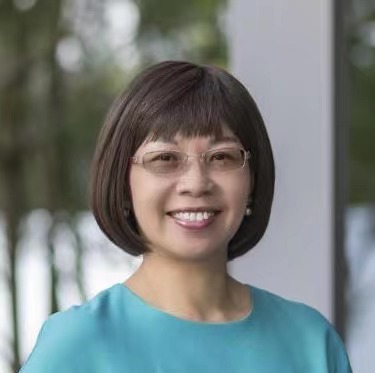
Associate Professor Zhang Wei
Director, LLM Programme
Yong Pung How School of Law
Built on SMU’s world-class business and finance research, our distinguished faculty with industry experience bridge the theory and practice and equip students with real-world knowledge. The holistic curriculum on commercial law, as well as professional study tours and networking opportunities, further advance students’ legal expertise and prospective careers.
We hope you find our programme interesting and challenging. Please review our brochure and contact us. We look forward to hearing from you and becoming part of your journey.
“The 21st century is a time of rapid change and extraordinary challenges. Globalisation has dramatically altered our lives and continues to shape them with significant impact on the economy, people and politics. Fast expanding digitalisation and relentless technological advances have only aided and exacerbated these changes. These changes have enormous ramifications for our laws and legal practice. Here at the Yong Pung How School of Law, our mission is to educate future-ready lawyers and professionals who will thrive in the midst of this legal evolution. Designed with that end in mind, our Master of Laws programme comprises four specialised tracks that seek to equip students with the competencies and perspective most pertinent to a global and digital economy. Students on this programme will be taught by our distinguished and experienced faculty members and visiting professors from diverse backgrounds. They will also have opportunities to interact with industry partners and renowned institutions that are intimately involved in shaping the laws of tomorrow.
I look forward to welcoming you to the SMU Yong Pung How School of Law.”
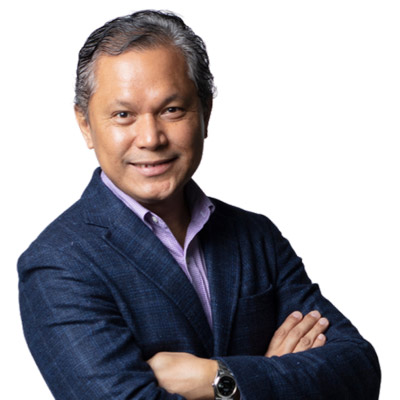
Professor Lee Pey Woan
Dean
Yong Pung How School of Law
Built on SMU’s world-class business and finance research, our distinguished faculty with industry experience bridge the theory and practice and equip students with real-world knowledge. The holistic curriculum on commercial law, as well as professional study tours and networking opportunities, further advance students’ legal expertise and prospective careers.
We hope you find our programme interesting and challenging. Please review our brochure and contact us. We look forward to hearing from you and becoming part of your journey.

Singapore, one of the world’s most cosmopolitan cities, has emerged as Asia’s legal and financial hub. As an integral part of the central business district where leading law firms and banks are located, Singapore Management University (SMU) is at the forefront of legal education.
The SMU LLM programme is carefully designed to expand your legal knowledge in classic and novel areas of the law, while simultaneously equipping you with the skills-sets essential to render on-point advice on cross-border transactions or deliver high-quality adjudication and judicial administration results.
Our professors who have gained insight from diverse work experiences will engage you with their interdisciplinary knowledge. Small class sizes allow for highly interactive seminars that also provide a challenging yet collegial learning environment. The School of Law’s active engagement with the legal community, as well as our strong alumni network and the Career Services team, immensely benefit students’ future careers.
The SMU LLM will offer you an unparalleled opportunity for advanced legal education in Singapore and Asia.


MASTER OF LAWS (LLM)
- Judicial Studies
- Cross-border Business and Finance Law in Asia
- Dual LLM in Commercial Law (Singapore & London)
- Law and Technology
SCIENTIFIC. ARTFUL. JUDICIOUS. TIMELY.

Advance your adjudication and administration abilities
- 6 core modules, including on judicial decision-making, judicial stress management and judicial philosophy
- 2 interdisciplinary electives
- 1-Year (Full-Time)
- 2-Year (Extended Duration)

Immerse yourself in the workings of the Singapore judiciary
- Internship opportunities to shadow sitting senior judges
- Attend fireside chats organised by the Singapore Judicial College
- Experienced judges (co)teach core courses and share first-hand accounts of their time in the courts
- Network with fellow judicial officers from around the region

Embark on a unique academic experience in Singapore
- Seminar-style pedagogy with interactive class discussion
- Practice-oriented content and ample use of court-centric case studies
- Specialised extra-legal courses on management strategies, accounting fundamentals and insights from social science
CROSS-BORDER BUSINESS AND FINANCE LAW IN ASIA

Sharpen your legal expertise and understand business practices
- 6 Core Modules
- 2 Electives or Dissertation
- 1 year (Full Time)
- 2 years (Part Time) for working professionals

Interact with global faculty and leading practitioners
- Distinguished faculty with diverse legal expertise in the Asia-Pacific
- Study tours to high-tech companies, international law firms and organizations
- Opportunities to network with legal, business and banking practitioners
- A class comprised of 70% international students with experience in countries such as Australia, China, France, India, Japan, the Philippines and Vietnam

Embark on a unique academic experience in Singapore
- Vibrant city campus in Asia’s legal and financial hub
- Specialized postgraduate courses on cross-border commercial law, intellectual property law and trade law
- Seminar-style pedagogy of interactive engagement in classes that teach students to solve real-world problems
- Participation in practice-oriented conferences on ASEAN and Singapore laws
EAST MEETS WEST: 1 PROGRAMME, 2 CITIES, 2 DEGREES

Sharpen your legal expertise and understand business practices
- Academically rigorous while providing a deep understanding of commercial law.
- Transit from theory to practice with actual case studies
- Allow students to explore widest possible career options

Interact with global faculty and leading practitioners
- Distinguished faculty with diverse legal expertise in Asia and Europe
- Study tours to high-tech companies, international law firms and organizations
- Opportunities to network with legal, business and banking practitioners

Embark on a unique academic experience in Singapore and London
- Vibrant city campus in the world's legal and financial hubs
- Seminar-style pedagogy of interactive engagement in classes that teach students to solve real-world problems
- Participation in practice-oriented conferences on Asian and European laws
LAW AND TECHNOLOGY
Sharpen your legal expertise and understand business practices
- Academically rigorous while providing a deep understanding of commercial law.
- Transit from theory to practice with actual case studies
- Allow students to explore widest possible career options
Interact with global faculty and leading practitioners
- Distinguished faculty with diverse legal expertise in Asia and Europe
- Study tours to high-tech companies, international law firms and organizations
- Opportunities to network with legal, business and banking practitioners
Embark on a unique academic experience in the two spheres of law and technology
- Vibrant city campus in the world's legal and financial hubs
- Seminar-style pedagogy of interactive engagement in classes that teach students to solve real-world problems
- Participation in practice-oriented conferences on Asian and European laws
"The experience is essential for prospective students from Taiwan to build a big picture of their personal vision by exploring beyond their comfort zones. “Thanks to the specialisation in ‘Cross-Border Business and Finance Law in Asia’ provided in the LLM programme, I acquired a wealth of new knowledge on emerging legal fields such as IT Law, Fintech, Financial Markets, Monetary Policy, and Digital Economy. It thus allows me to think of new projects and gain easier access to new legal fields. For example, I recently established a new virtual law firm in the virtual world, to provide legal consultancy on IPR issues.
Looking back, studying law in Singapore is truly a milestone. I think I would never start a new trajectory or deal with a matter that is still evolving in the context of a rapidly evolving technology and innovation environment if I didn't study at SMU."

Lai Yi-An (Taiwan)
Partner, Chien Yeh & Associates, Taiwan
Class of 2019
“When my son finished his undergraduate studies at SMU's Lee Kong Chian School of Business, his transformation was palpable in the way he expressed himself, and how he framed discussion points. I told myself that studying in SMU for my LLM may not be a bad idea. I browsed the modules offered which I thought were forward-looking and future relevant. I believe I made the right choice in SMU with its excellent professors, modern facilities, and convenient location.
I particularly liked the comparative approach taken in each module, which enabled us to discuss relevant legal issues from local to regional to global perspectives. The modules I took made my development holistic as they transcended legal matters – learnings which I shared with my team and applied at work when I returned to corporate.”
Archilo Arcayan Matugas (Philippines)
Vice-President for Corporate Governance, SMART Communications Inc.
Class of 2019
"Connections between Asia and Europe are intensifying, with a knock-on effect on the need for cooperation among individual countries located on these continents. The LL.M. programme at SMU aims to instil a global outlook and prepare the international lawyer for the important role she has to play in building new bridges between different parts of the world and different areas of practice.
I am glad to have had the chance to be part of this programme which has given me the valuable opportunity to acquire relevant knowledge and skills across the fields of law business. I now feel much better equipped to compete in a globalized working environment."

Sarah Giammatteo (France)
Legal Counsel, Socomec, Singapore
Class of 2019
"Before joining the LL.M. programme at SMU, I had already obtained two law degrees – a Master of Laws in the U.S. and Juris Doctor in Korea. In contrast to those two degrees, SMU’s programme gave me an opportunity to think about and approach legal issues from a wide variety of angles, including non-legal ones. Class activities were challenging, fun and promised growth in the legal profession. I feel privileged to have been in a cohort with brilliant legal professionals from a range of other jurisdictions, who made every discussion an enriching experience. The Kwa Geok Choo Law Library is fantastically well-equipped with all the materials students need. I would definitely recommend SMU’s LL.M. programme to friends who would like to further develop themselves with a view to reinvigorating their career. It has been a life-changing experience!"
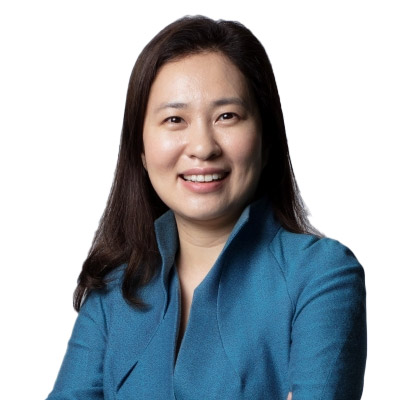
Son Hiyoung (South Korea)
Foreign Lawyer, Oon & Bazul LLP
Class of 2019
Before embarking on the LL.M. programme at SMU, I practiced in Korea for more than seven years. I felt like I was flat-lining in my career and was unsure about the future direction I ought to take. However, with this programme, I regained my passion for the law and the hunger for new challenges that I lost. Every class started with curiosity about the points raised in the assigned readings and ended with gratification of my intellectual thirst. Moreover, I was able to make wonderful friends from around the world. I firmly believe that SMU’s LL.M. programme is a doorway to success for me, and I’m sure that the same will be true for others.
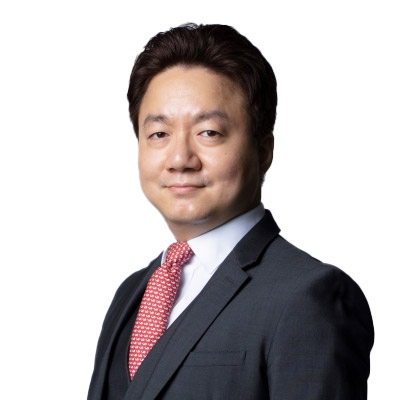
Park Suyung (South Korea)
Foreign Lawyer, Oon & Bazul LLP
Class of 2019
It was a privilege for me to be enrolled in the SMU LL.M. programme. The curriculum is up-to-date, covering topics relevant to the modern business world like fintech and data protection. I enjoyed learning from the professors, who are experts in their field. It was also very interesting to hear the diverse perspectives and approaches shared by my fellow students as ours was a truly cosmopolitan cohort. My most memorable experience was the "rite of passage" all of us all went through to be accredited as professional mediators.
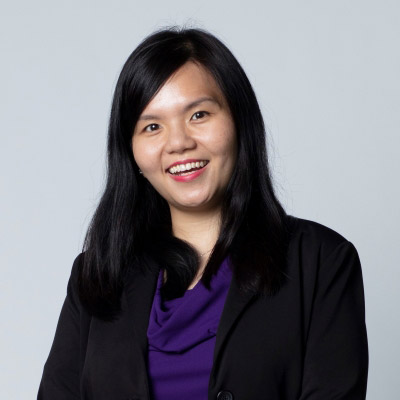
Chew Wan Lin (Singapore)
Senior Assistant Director,
Transnational and Financial Crimes Division, Ministry of Home Affairs
Class of 2019
In order to become a global lawyer and assist the expansion of multinational businesses, it is mandatory for one to have an exposure to the ASEAN region. SMU, while located in the heart of one of the most relevant financial hubs of the world, offers deep insights about this fast-growing environment and teaches its students how to better guide your way to legal certainty in the region. This LL.M experience will definitely assist me to become more qualified and prepared as a cross-border legal professional in the future.

Luiz Piauhylino De Mello Monteiro Neto (Brazil)
Wealth Management Lawyer
Nogueira Pegas Advogados, Brazil & Portugal
Class of 2017
I have always felt grateful that I had the opportunity to be admitted to the LL.M. programme in SMU, which enriched me with relevant knowledge and skills. To participate in those highly interactive and stimulating seminars not only trained me to speak up and share ideas in public with courage, but also helped me adapt to the real working environment well in advance. Most importantly, I have established precious friendship from different countries with cultural diversity that I will cherish all my life.

Nicole Zheng Li Ming (China)
Registered Foreign Lawyer, Singapore
Class of 2016
The world needs legal professionals who master business. The ones who are only familiar with law are no longer suitable for today’s complex business environment. For any candidate who plan to learn law from a business perspective and learn business from a legal perspective, SMU LL.M. is the best choice!

Kazumasa Miyashita (Japan)
Japanese qualified lawyer (bengoshi)
Industrial Growth Platform Pte. Ltd., Singapore
Class of 2017
The SMU LLM was an intellectual challenge that really added to my knowledge base and broadened my experience. The academics are subject matter experts in their own right and many are well respected business professionals in addition. The city campus location suited me as did the strong business and practical orientation of the subjects taught. It adds to my future career options. I learned a lot from my fellow students, many of whom are from diverse geographies and career experience. The course is taught from a regional and international perspective and helps you to understand the similarities and differences between the legal jurisdictions. I appreciated the fresh perspective of the SMU experience, and I enjoyed the LLM from start to finish!
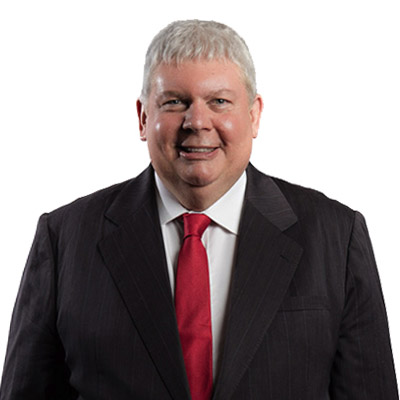
Bill Bowman (Australia)
Senior Director, Risk Management and Internal Control
Infineon Technologies Asia-Pacific Pte Ltd
Class of 2016
I joined the LL.M. programme in Singapore in 2015 and lived my lifetime experience of being a student again. I had an opportunity to pursue specific areas of interest that I developed during my career: cross-border transactions and foreign investment law. The SMU LL.M. programme helped me to gain sophisticated business approach and understanding of doing cross-border business in Asia, regulatory framework, transactional integration and importance of multicultural legal teams. I am grateful to the fundamental experience I had gained and new professional society I joined for my professional and personal growth. Thank you SMU for connecting all our diverse experiences together.

Nino Chantladze (Russian Federation)
Russian qualified lawyer, Moscow
Class of 2016
The SMU Master of Laws programme has enabled me a broader context in business and the world through international laws and regulations. The understanding gained has significantly improved my ability to reason and respond to situations at work and in my personal life. The relationships and knowledge gained through the programme have afforded me the opportunities to volunteer and support communities at work and at SMU, including the SMU Alumni Association, the SMU Office of Alumni Relations as an Alumni Ambassador, and as a SMU Mentor. I particularly appreciated the Socratic teaching approach for the programme which allows the teacher and students to interact and share their viewpoints, and learn from one another in a structured manner.
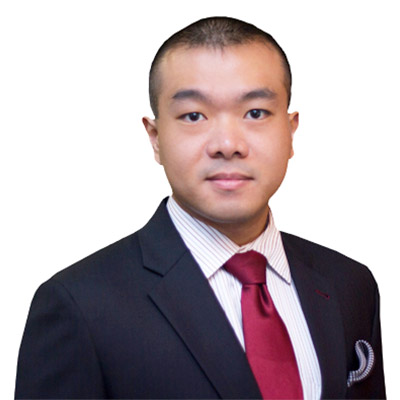
Teo Xiang Zheng (Singapore)
Class of 2015
I found the SMU's LLM programme beyond helpful in the development of my career. The school has a unique interactive pedagogy which facilitates experiential learning and sharing of valuable insight amongst classmates with diverse working backgrounds. The fundamentals of law was also emphasised so I was able to focus what I needed to excel in an academic setting with a certain specialisation. The course delivery, faculty and staff were intellectually stimulating and jurisprudentially enlightening. Overall, my study in SMU greatly improves my productivity at work in assessing legal risks in the banking industry.

Fazrihan Bin Mohamed Duriat (Singapore)
Class of 2015


Start Your Journey
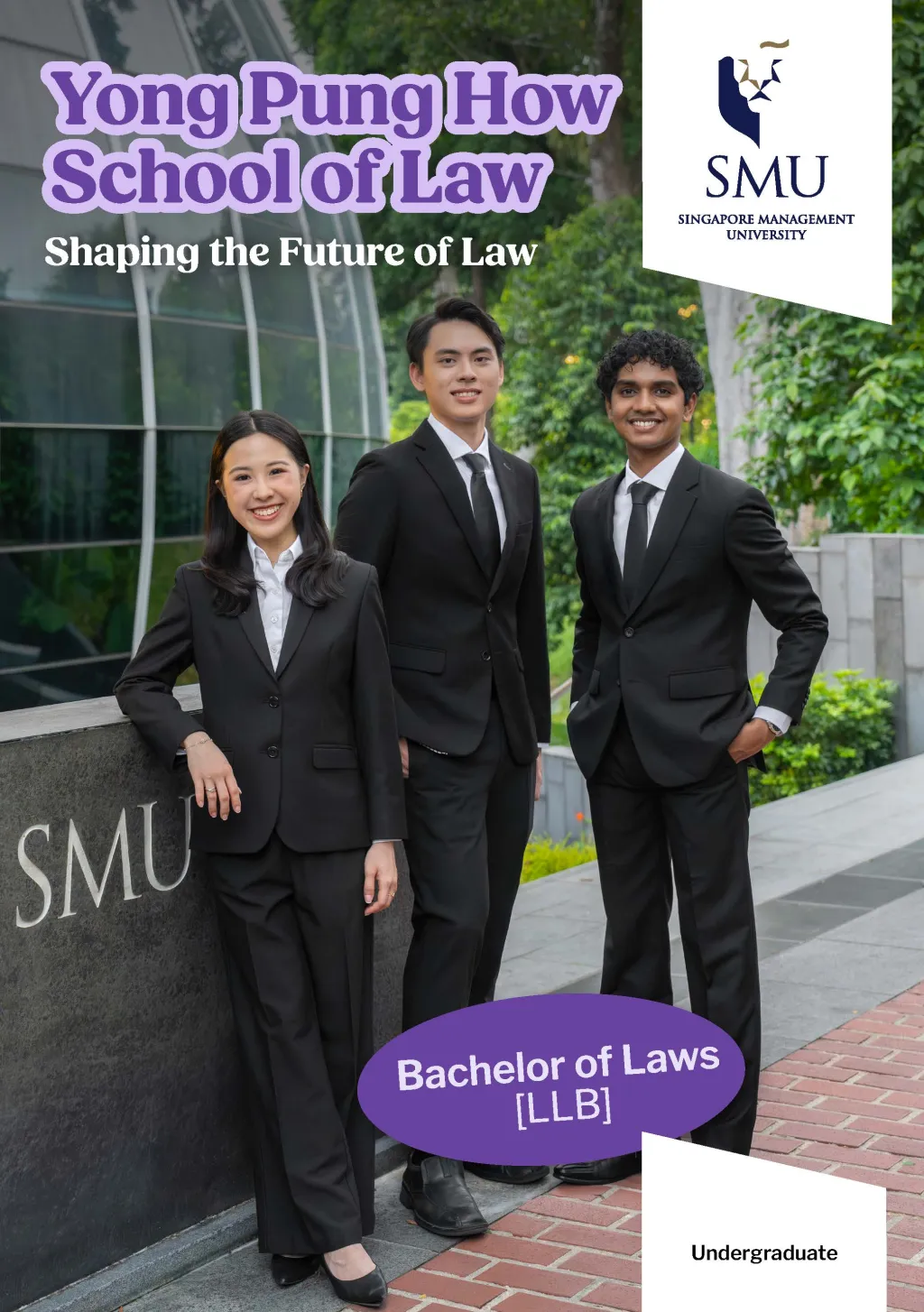
Undergraduate

POSTGRADUATE

RESEARCH & FACULTY
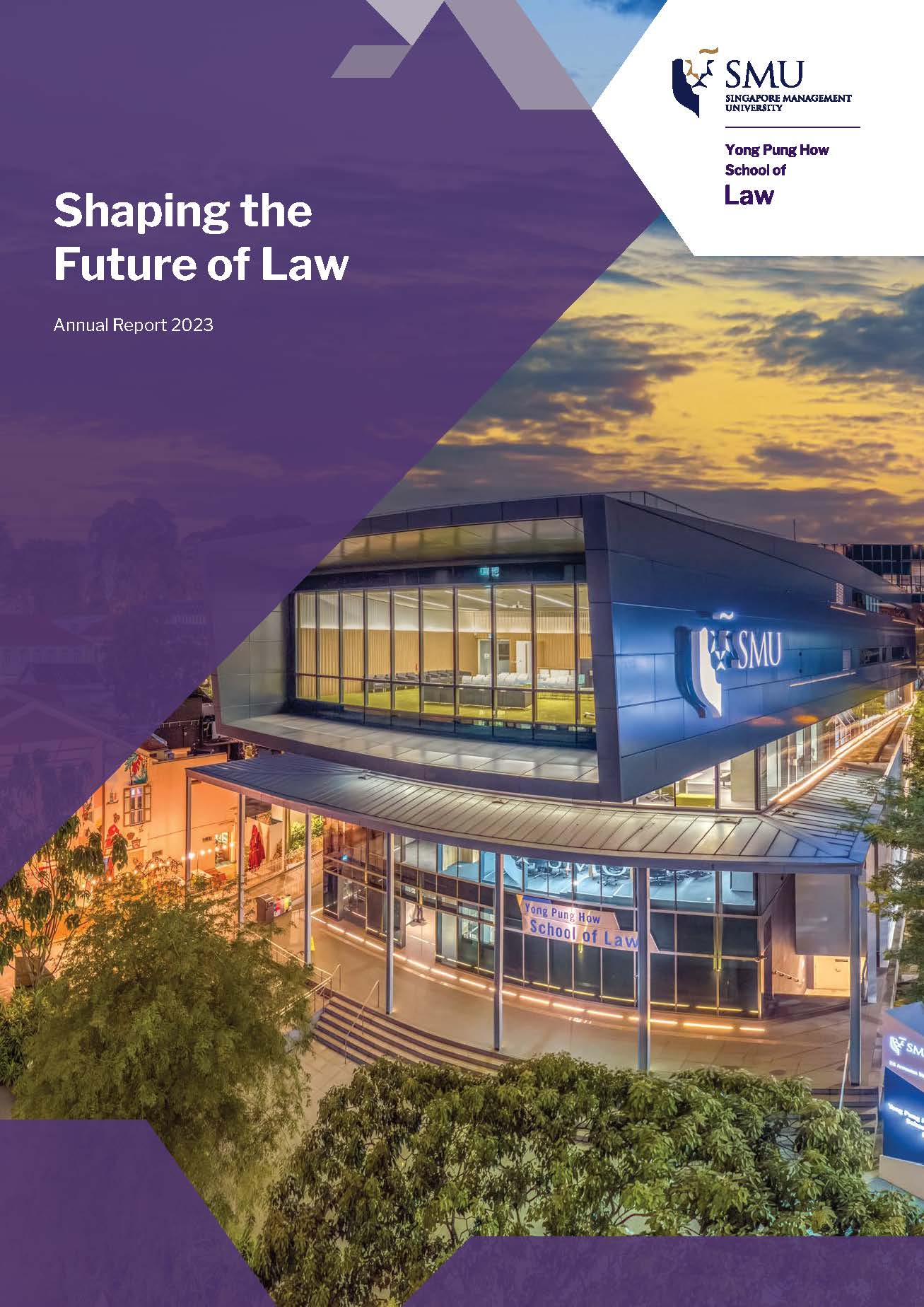
Recent Reports And E-Publications

Looking for something?
Yong Pung How School of Law At A Glance
9th
BEST YOUNG UNIVERSITY
IN THE WORLD
#11
AMONGST SPECIALIST
UNIVERSITIES WORLDWIDE
*Source: QS World University Rankings 2017 & QS Top 50 List (Age 10-25 Years)
60+-time International Moots Champion since 2010
Find out more about our International Moots Programmes
Our graduates enjoyed an
OVERALL EMPLOYMENT RATE OF
95.9%
MEDIAN GROSS MONTHLY SALARY
of up to
$7,000*
*MOE Graduate Employment Survey 2024 (Published in Feb 2025)
Follow Us
Follow us for the latest happenings at the SMU School of Law:
Upcoming Events
REGISTER INTEREST IN SMU LAW PHD PROGRAMME
You may register your interest in the SMU Law PhD programme to receive updates on programme information and upcoming admission events.
| DATES | EVENT | DETAILS |
| Upon Registration | SMU Law PhD Programme 1-On-1 Consultation Welcome to SMU PhD programme 1-On-1 Consultation. Register now and you will have 20 mins to talk with our recruitment manager. It will allow us to pre-access your eligibility and reply to your questions about programme and application. Time: TBC (Singpaore Time Zone) Venue: Zoom meeting (a confirmation email with zoom meeting link will be sent to registered email upon successful registration) Notes:
| COMING SOON |