
Pro Bono Service
As part of graduation requirements, J.D. students are to complete 20 mandatory hours of pro bono work in their 2nd or 3rd year. More details on pro bono work can be found here
The SMU J.D. is a 3-year full-time programme only, which comprises of 23 courses totaling 25 course units (Each course carries one course unit unless stated otherwise). The part-time J.D. programme is not available at SMU. Regardless of identification, JD students are not able to work during the programme due to intensive course schedule.
2022 ADMISSION COHORT ONWARDS
With effect from the 2022 admission cohort, the programme structure is revised as such:
| Law Core (17.0 course units) | + | Law Electives (8.0 course units) |
| Internship and Pro Bono Service | ||
The curriculum is designed to be completed in 3 years but the programme may be accelerated in some cases for completion within 2 years subject to the approval of the J.D. Committee, which will take into consideration their first term's exam grades.
In order to graduate, students are also required to undertake 6 weeks of internship and clock 20 hours of Pro Bono service.
Illustrative 3-year Programme (cu = course unit)
(Core modules have to be done in the year and term stated. Approval is required for any deferrals to Year 2 core modules).
| 3-Year Full-time Programme Only | |||
| Year 1 | Year 2 | Year 3 | |
| Term 1: Aug - Dec | Contract Law 1 | Corporate Law (1.5cus) | Legal Theory and Philosophy |
| (15 weeks) | Criminal Law (1.25cu) | Law of Property (1.25cu) | Commercial Conflict of Laws |
| Legal Research Writing | Law Elective 2 | Capstone Project* | |
| Singapore Legal System (0.5cu) | Law Elective 3 | Law Elective 6 | |
| December Break | |||
| Term 2: Jan - Apr | Contract Law 2 | Constitutional and Admin Law (1.5cu) | Law of Evidence |
| (15 weeks) | Law of Torts (1.5cu) | Law of Equity and Trust (1.5cu) | Law Elective 7 |
| Legal Research Writing II (0.5cu) | Law Elective 4 | Law Elective 8 | |
| Comparative Legal Systems (0.5cu) | Capstone Project* | ||
| Summer Term 3A: May - Jun (5 weeks) | Law Elective 1 | Law Elective 5 | |
| Summer Term 3B: Jun - Jul (5 weeks) | Internship (6 weeks) | ||
| Summer Break: Jul - Aug (4 weeks) | Pro Bono (20 hours) | ||
*Capstone Project core can be done in either Year 3 Term 1 or Year 3 Term 2.
2021 ADMISSION COHORT
With effect from the 2021 admission cohort, the programme structure is revised as such:
| Law Core (17.5 course units) | + | Law Electives (7.5 course units) |
| Internship and Pro Bono Service | ||
The curriculum is designed to be completed in 3 years but the programme may be accelerated in some cases for completion within 2 years subject to the approval of the J.D. Committee, which will take into consideration their first term's exam grades.
In order to graduate, students are also required to undertake 6 weeks of internship and clock 20 hours of Pro Bono service.
Illustrative 3-year Programme (cu = course unit)
(Core modules have to be done in the year and term stated. Approval is required for any deferrals to Year 2 core modules).
| Year 1 | Year 2 | Year 3 | |
| Term 1: Aug - Dec | Contract Law 1 | Corporate Law (1.5cus) | Legal Theory and Philosophy |
| (15 weeks) | Criminal Law (1.25cu) | Law of Property (1.25cu) | Commercial Conflict of Laws |
| Legal Research Writing | Law Elective 2 | Capstone Project | |
| Singapore Legal System (0.5cu) | Law Elective 3 (0.5cu) | Law Elective 6 | |
| December Break | |||
| Term 2: Jan - Apr | Contract Law 2 | Constitutional and Admin Law (1.5cu) | Law of Evidence |
| (15 weeks) | Law of Torts (1.5cu) | Law of Equity and Trust (1.5cu) | Law Elective 7 |
| Legal Research Writing II (0.5cu) | Law Elective 4 | Law Elective 8 | |
| Comparative Legal Systems | |||
| Summer Term 3A: May - Jun (5 weeks) | Law Elective 1 | Law Elective 5 | |
| Summer Term 3B: Jun - Jul (5 weeks) | Internship (6 weeks) | ||
| Summer Break: Jul - Aug (4 weeks) | Pro Bono (20 hours) | ||
UNTIL 2020 ADMISSION COHORT
| Law Core (18.5 course units) | + | Law Electives (6.5 course units) |
| Internship and Pro Bono Service | ||
The curriculum is designed to be completed in 3 years but the programme may be accelerated in some cases for completion within 2 years subject to the approval of the J.D. Committee, which will take into consideration their first term's exam grades.
In order to graduate, students are also required to undertake 6 weeks of internship and clock 20 hours of Pro Bono service.
Illustrative 3-year Programme (cu = course unit)
(Core modules have to be done in the year and term stated. Approval is required for any deferrals to Year 2 core modules).
| Year 1 | Year 2 | Year 3 | |
| Term 1: Aug - Dec | Contract Law 1 | Corporate Law | Legal Theory and Philosophy |
| (15 weeks) | Criminal Law (1.25cu) | Law of Property (1.25cu) | Commercial Conflict of Laws |
| Legal Research Writing | Constitutional and Admin Law (1.5cu) | Law Elective 3 | |
| Singapore Legal System (0.5cu) | Ethics and Social Responsibility for Law | Law Elective 4 (0.5cu) | |
| December Break | |||
| Term 2: Jan - Apr | Contract Law 2 | Comparative Legal Systems | Law Elective 5 |
| (15 weeks) | Law of Torts (1.5cu) | Law of Equity and Trust (1.5cu) | Law Elective 6 |
| Law of Business Organisation | Law of Evidence | Law Elective 7 | |
| Legal Research Writing II (0.5cu) | |||
| Summer Term 3A: May - Jun (5 weeks) | Law Elective 1 | Law Elective 2 | |
| Summer Term 3B: Jun - Jul (5 weeks) | Internship (6 weeks) | ||
| Summer Break: Jul - Aug (4 weeks) | Pro Bono (20 hours) | ||
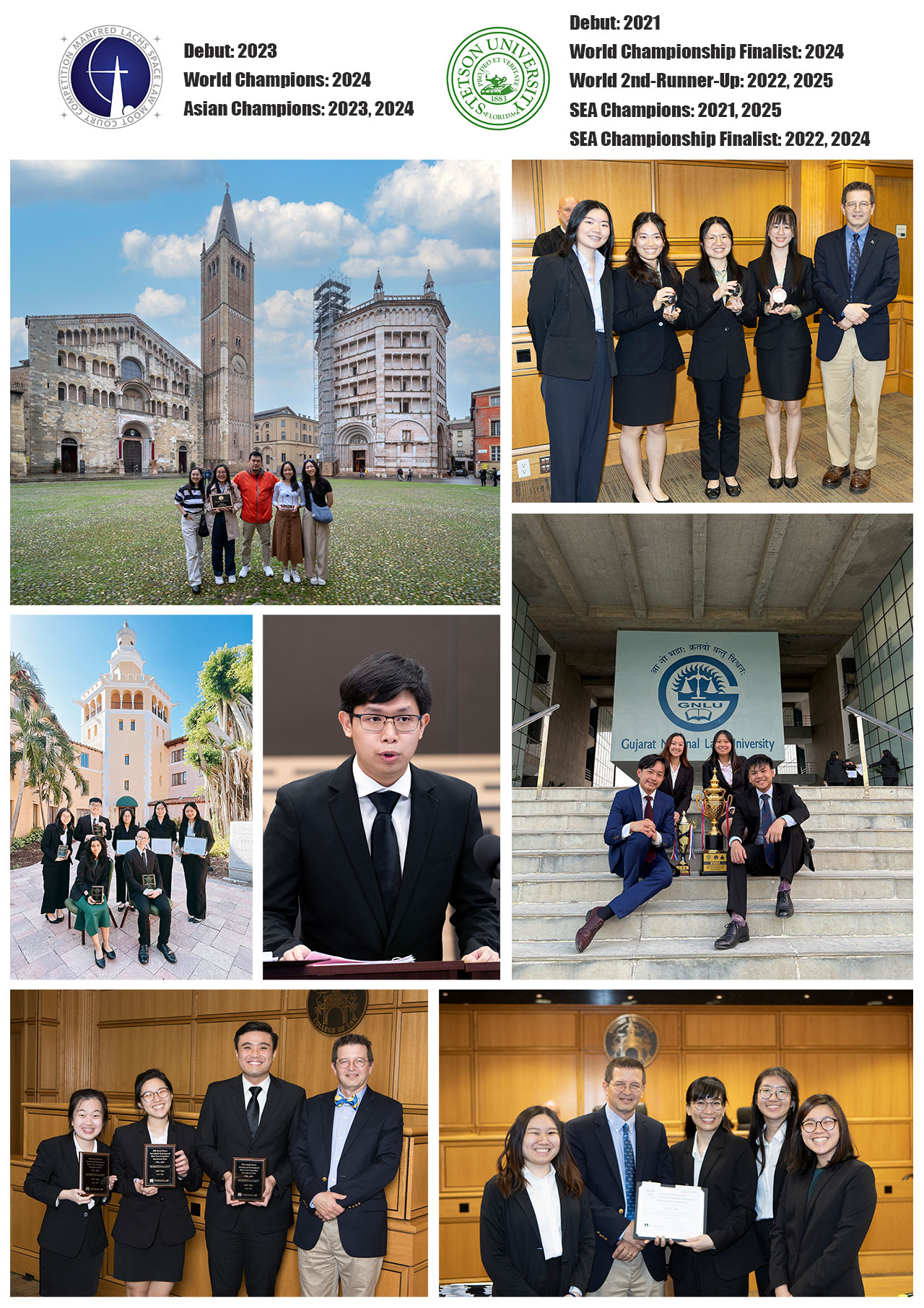
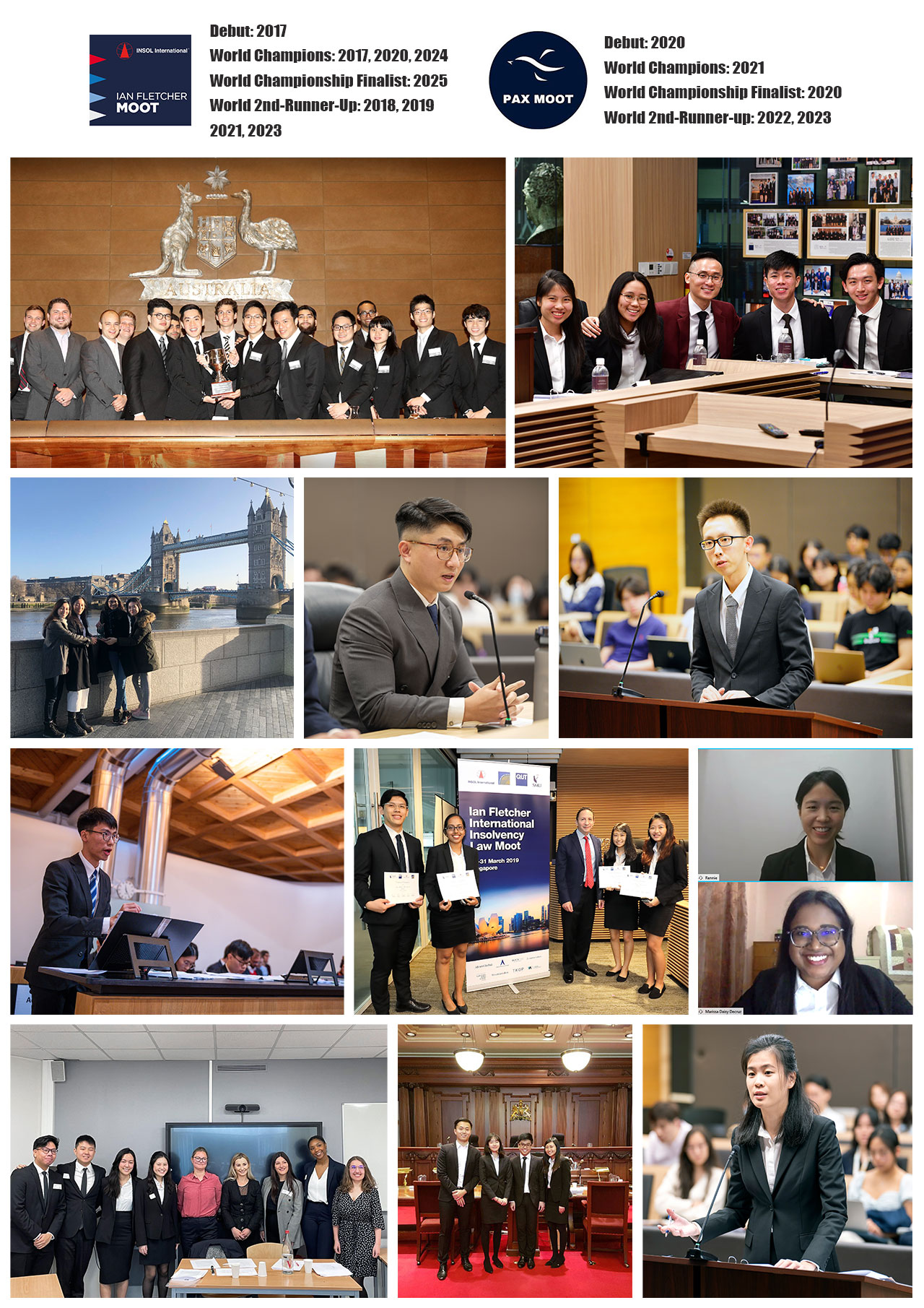
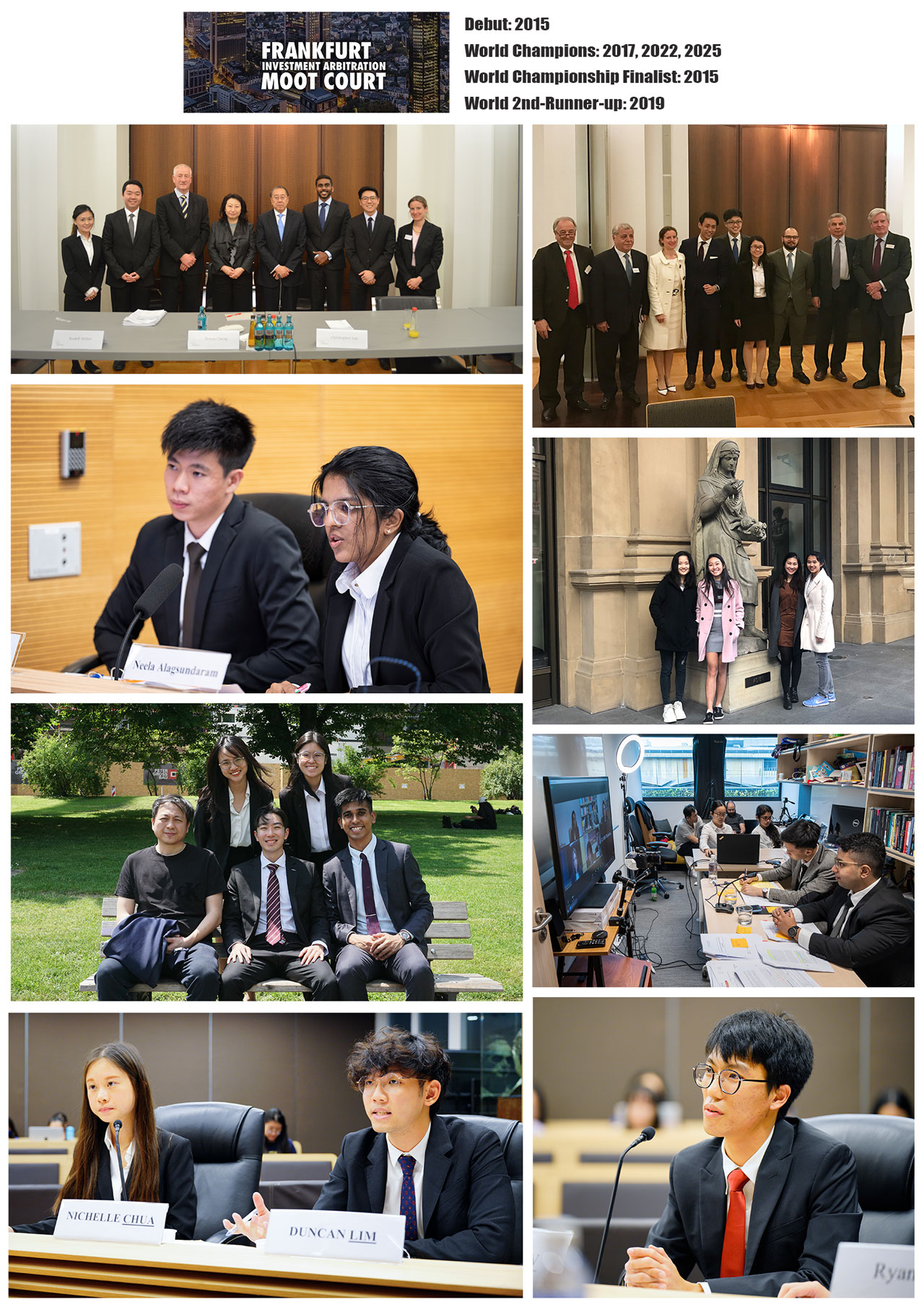
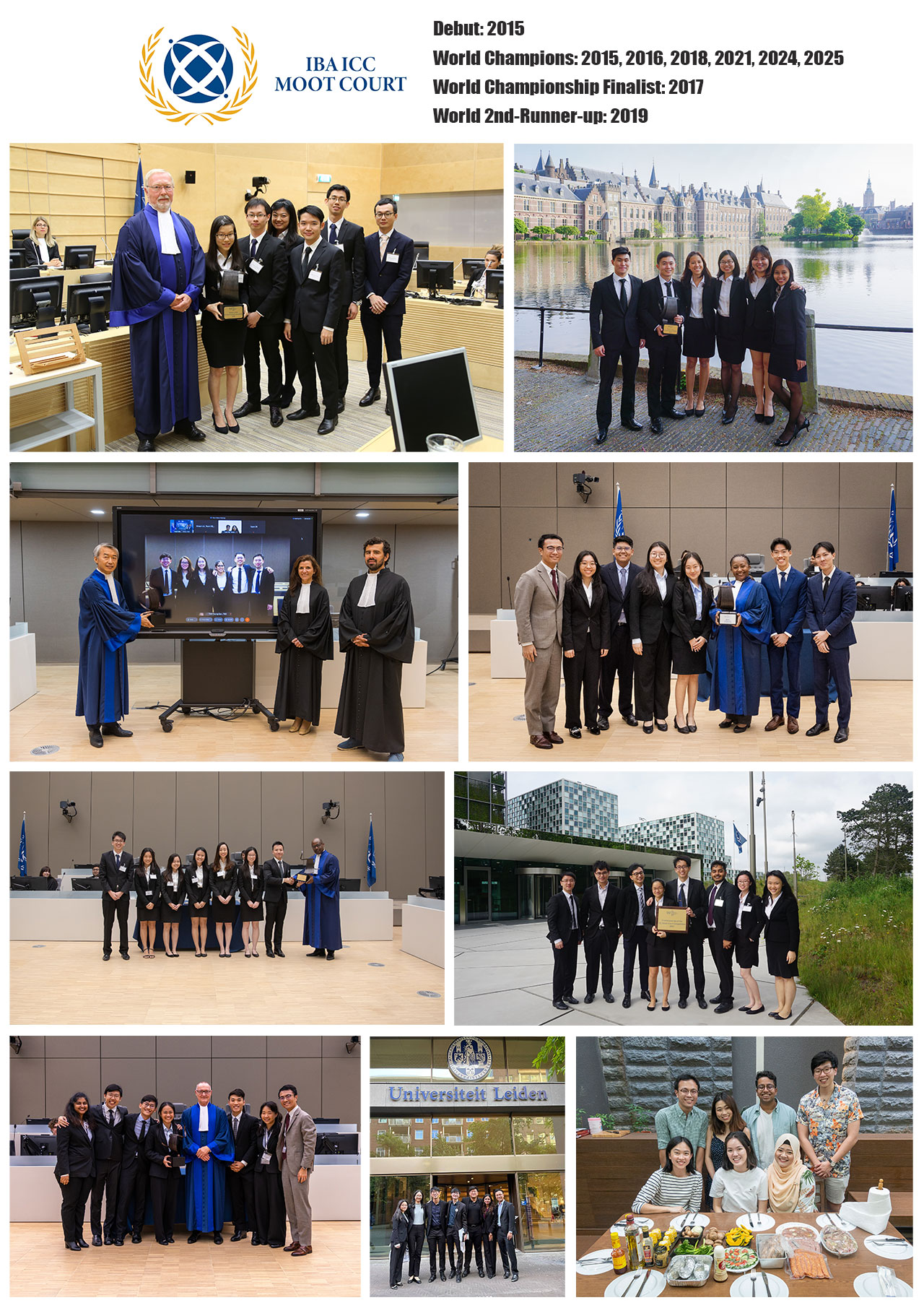
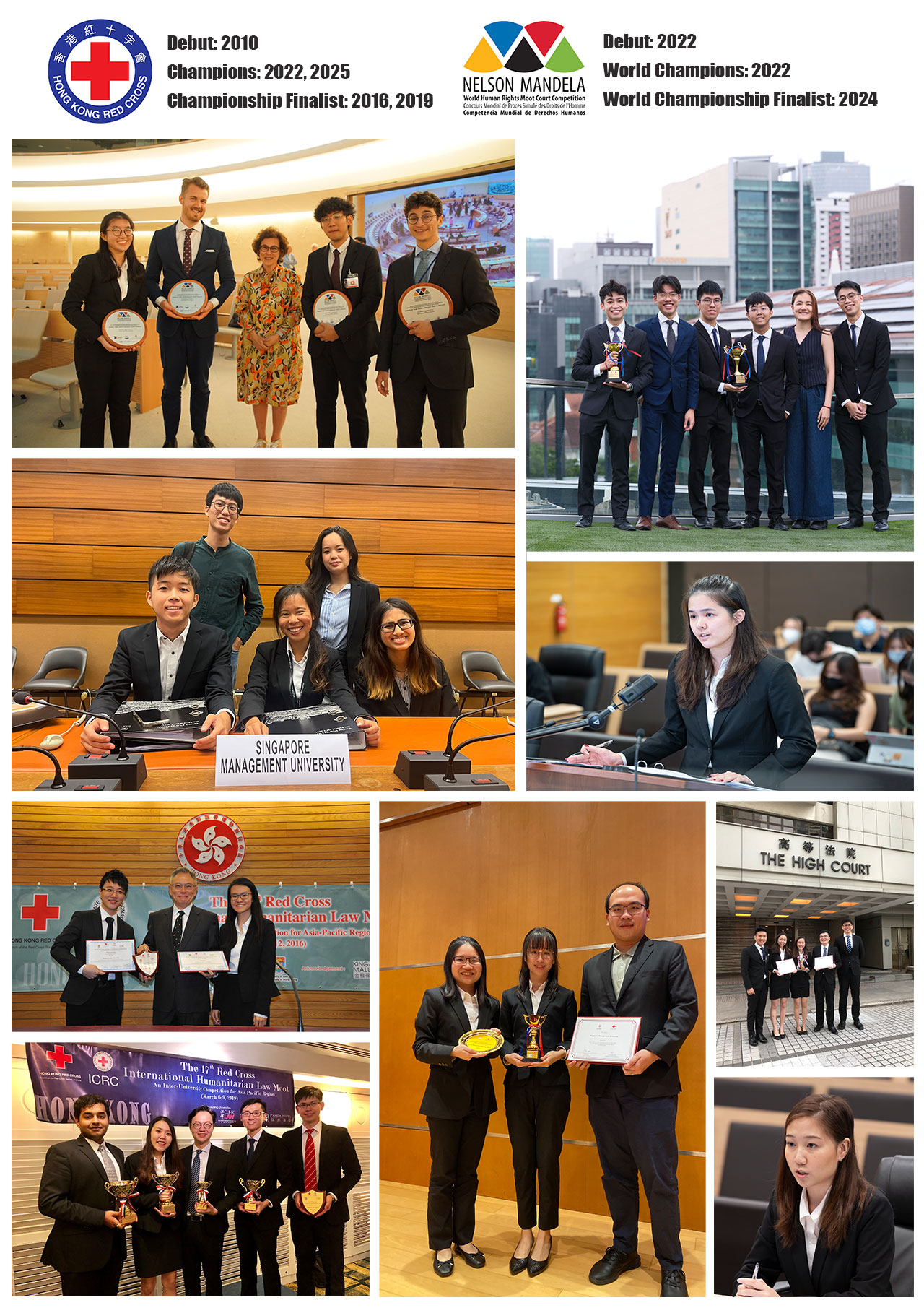
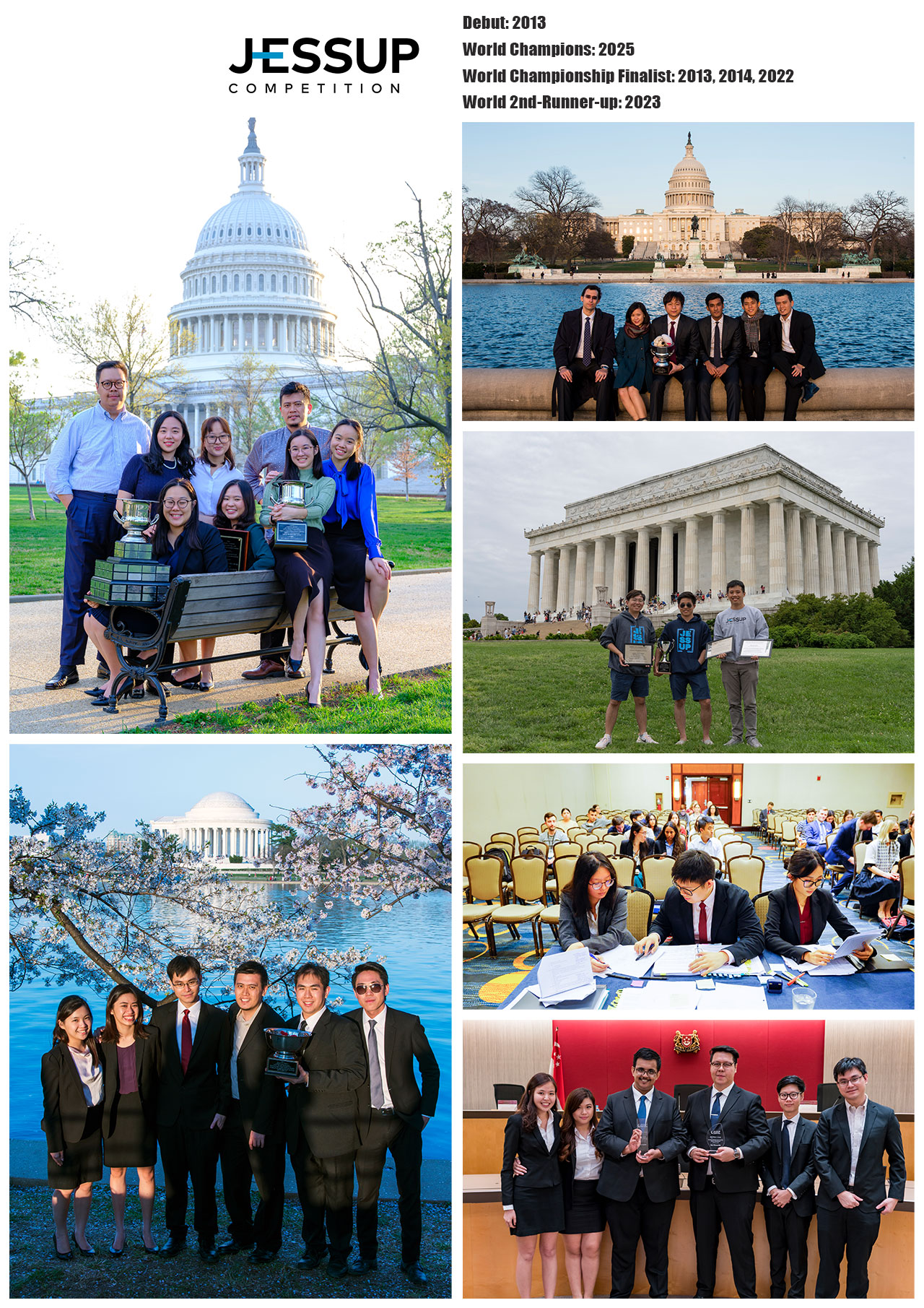
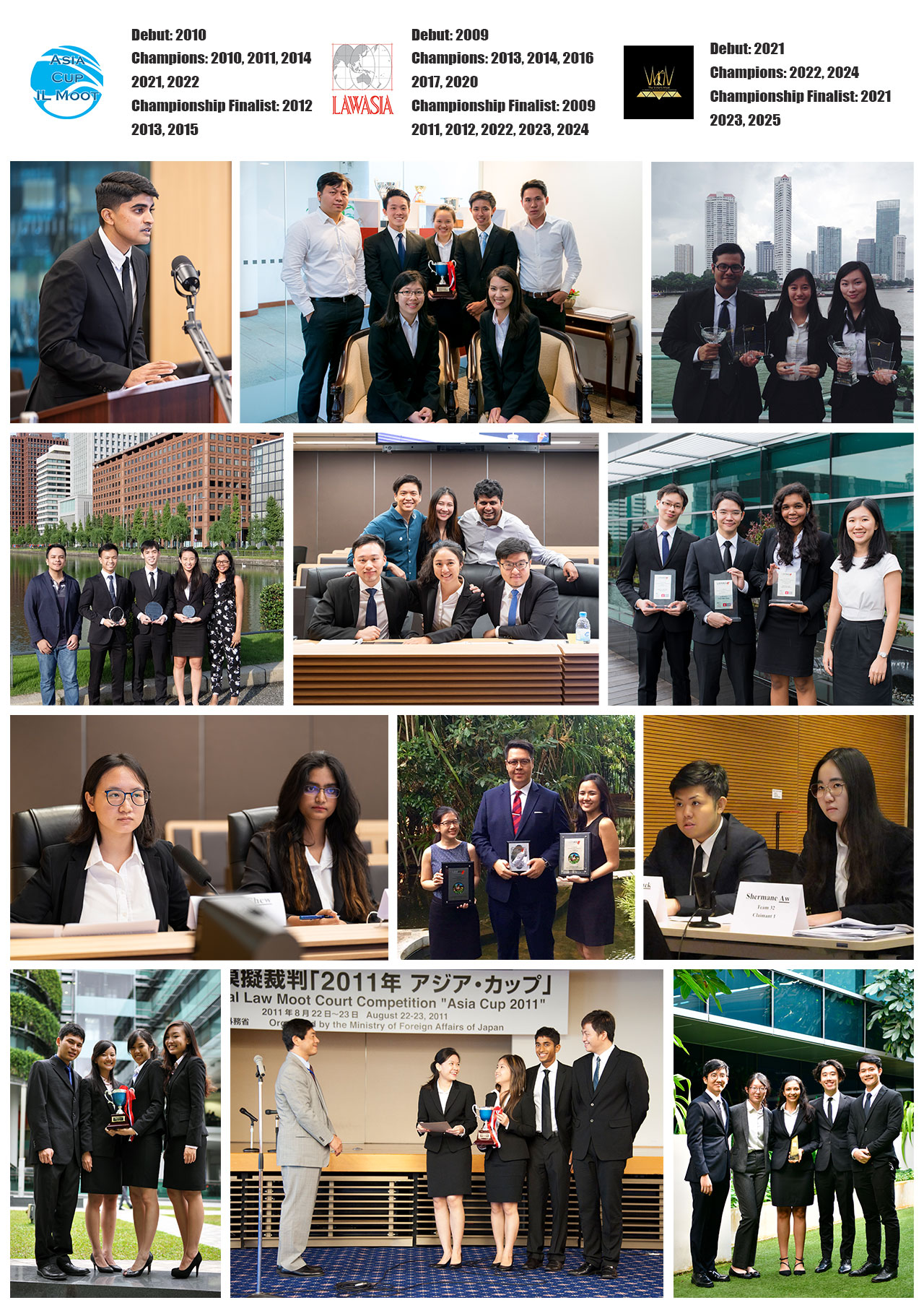
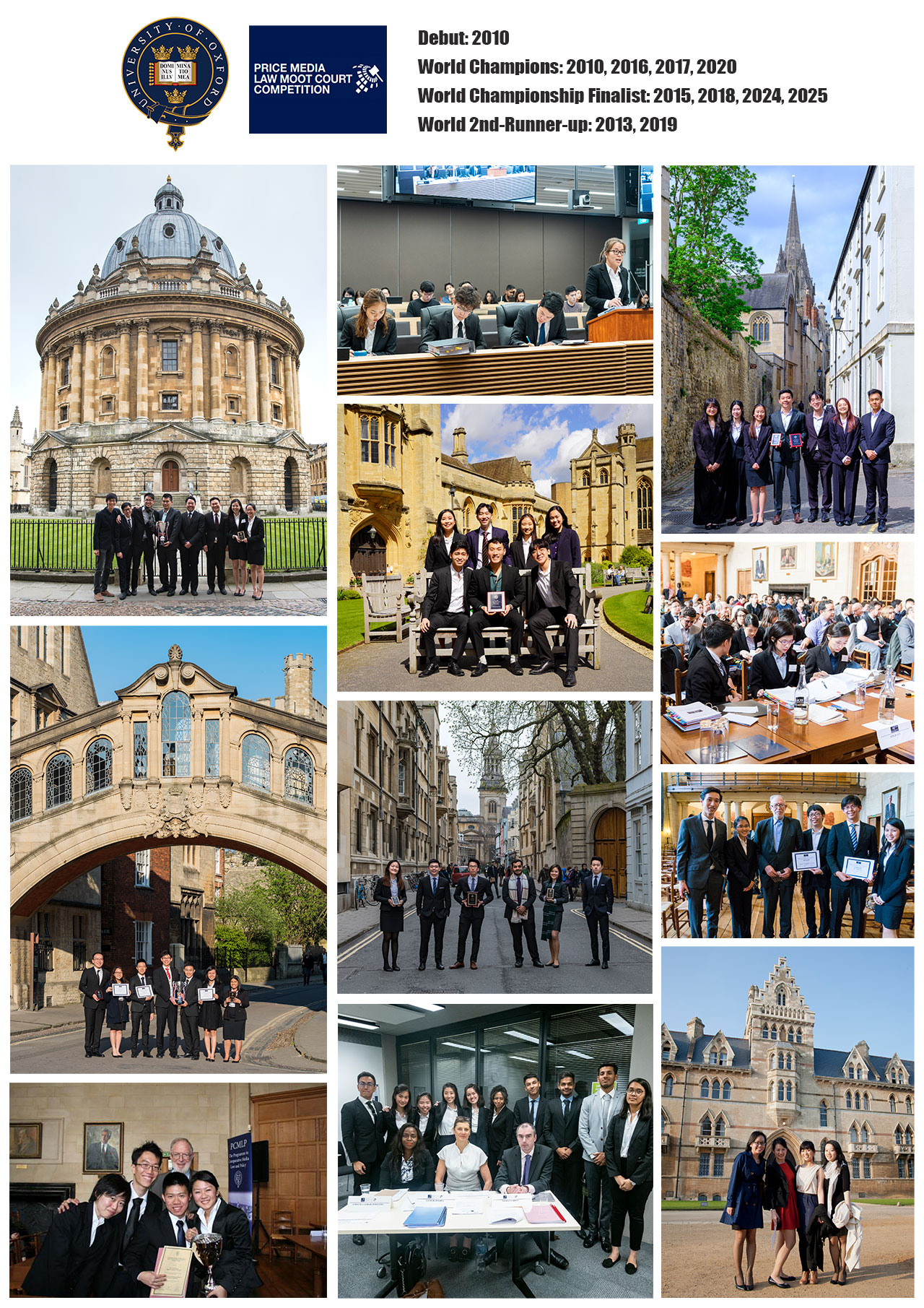
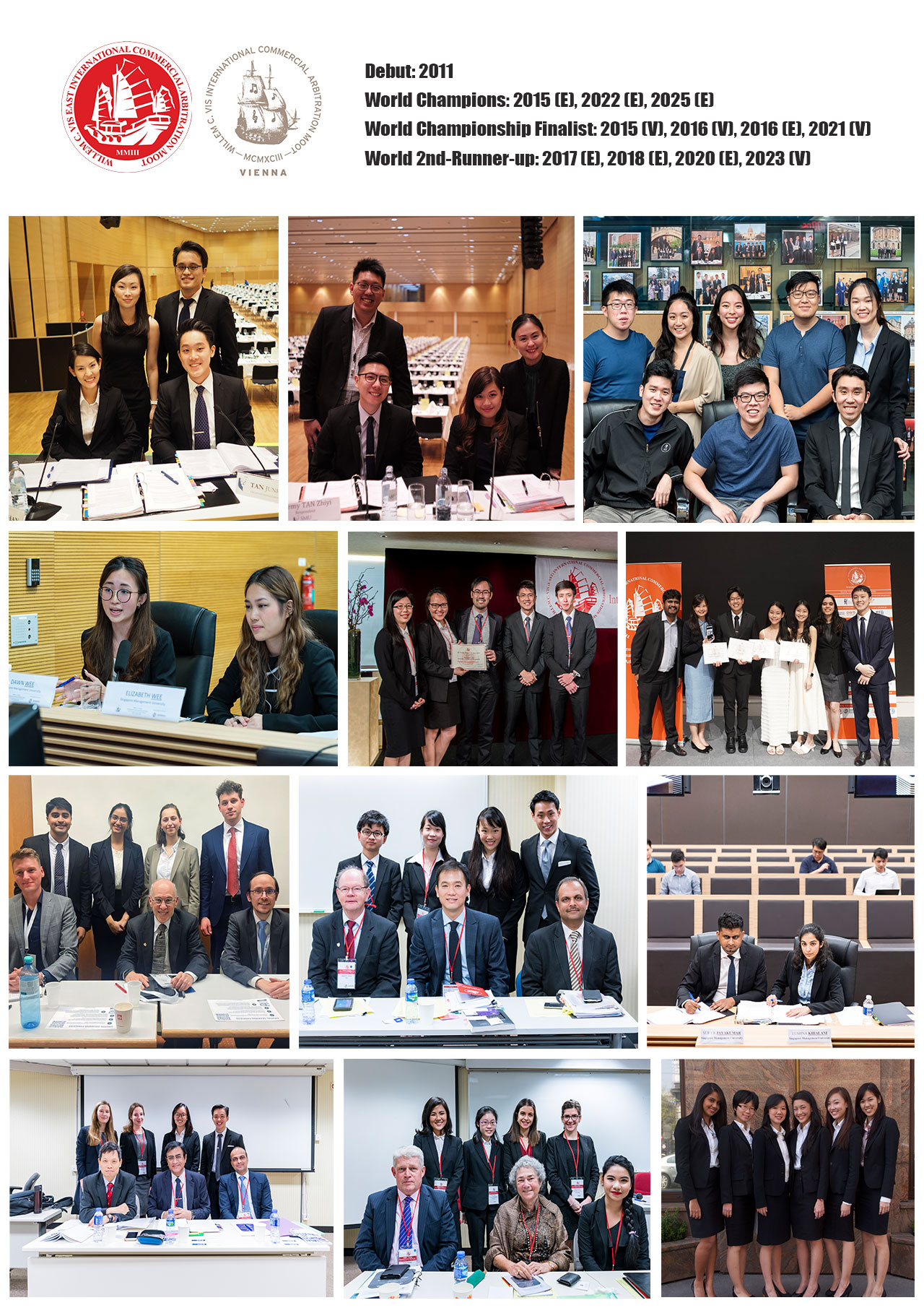
There is no better way to acquire the fundamental skills of analysis, research, writing, and advocacy required for legal practice, and there is also no better way to be connected to the vast network of junior and senior lawyers that SMU’s pool of coaches and judges now comprise, than to do an international moot in SMU.
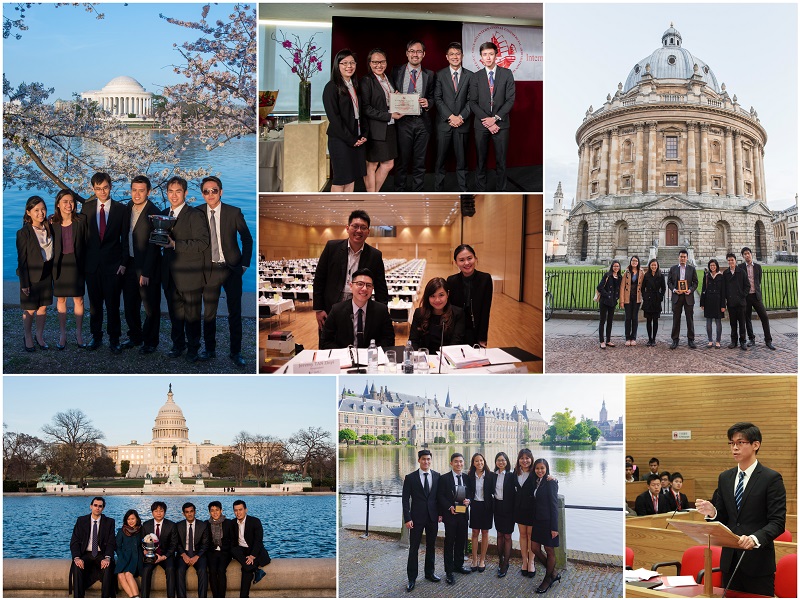
Here are the past winners & finalists from the J.D. Programme:
| Title | J.D. Involvement |
WongPartnership LLP Arbitration Moot 2019 | Nur Liyana Binte Kamaludin (Champion) |
| Title | J.D. Involvement |
Monroe E. Price Moot | Trishna Menon |
International Criminal Court (ICC) Moot Court Competition (Champion) | Lee Chuan |
Willem C. Vis International Commercial Arbitration Moot | Trishna Menon |
| Title | J.D. Involvement |
Frankfurt Investment Arbitration Moot 2017 (Winner) | Luis Duhart Gonzalez |
Essex Court Chambers-SAL International Mooting Competition (Winner) | Nicholas Liu, J.D. Graduate Class of 2015 Bethel Chan, J.D. Graduate Class of 2016 |
| Title | J.D. Involvement |
Willem C. Vis International Commercial Arbitration Moot 2016 (Finalist) | Won Chian Lim Tiffany Tseng Ai Mei |
International Criminal Court Moot 2016 (Winner) | Saw Teng Sheng |
MLAS Maritime Mooting Competition 2016 (Winner) | Nicholas Liu Sheng; J.D. Graduate Class of 2015 (First) |
Monroe E. Price Moot 2016 (Winner, Best Memorial) | Jevan Li Xianliang |
| Title | J.D. Involvement |
Willem C. Vis (East) International Commercial Arbitration Moot 2015 (Winner) | Jason Lim Tiong Garn |
Willem C. Vis International Commercial Arbitration Moot 2015 (First runner-up) | Bethel Chan Ruiyi (Honorable Mention for Best Oralist) Alvin Tan Yue Shuen |
WTO-FTA Moot 2015 (Winner) | Nicholas Liu Sheng (Best Oralist, Final Round) |
Philip C. Jessup Moot 2015 - National Round (Winner) | Nicholas Liu Sheng (Best Oralist and Best Memorial) |
Philip C. Jessup Moot 2015 - International Round | Nicholas Liu Sheng (9th overall for Best Oralist) |
Monroe E. Price Moot 2015 (Finalist) | Geraldine Kuah Wen Ling (Top 5 for Best Oralist) |
International Criminal Court Moot 2015 (Winner, Best overall team) | Alexis Ang Jingsi |
Frankfurt Investment Arbitration Moot 2015 (First runner-up) | Benjamin Bala Jeremy Tan Zhiyi Tiffany Tseng Ai Mei |
| Title | J.D. Involvement |
Stamford Law Corporate Moot 2014 (Runner-up) | Nicholas Liu Sheng |
Philip C. Jessup Moot 2014 -National Round (Winners) | Nicholas Liu Sheng |
Philip C. Jessup Moot 2014 -International Round (First runner-up) | Nicholas Liu Sheng (Best Oralist) |
Monroe E. Price Moot 2014 (Quarter Finals) | Alexis Ang Jingsi Jason Lim Tiong Garn Alvin Tan Yue Shuen |
Asia Cup 2014 (Winner) | Bethel Chan Ruiyi |
| Title | J.D. Involvement |
Wong Partnership LLP Arbitration Moot 2013 (Finalist) | Jeremiah Cunningham (joint 2nd runner-up) |
Monroe E. Price Moot 2013 (Semi- Finals) | Adriel Chia Teck Yew |
International Maritime Law Arbitration Moot 2013 (Quarter Finals, Best Newcomer Award) | Jeremiah Cunningham Benjamin Mui Jie Min (top 10 for Best Oralist) Kim Beverly Samson Joey Pang Keep Ying (top 10 for Best Oralist) |
Harry Elias-SMU Moot 2013 (Winner) | Nicholas Liu Sheng (Best Oralist and Best Memorial) |
NUS Advocacy Cup 2013 (Winner) | Nicholas Liu Sheng (Champion) Kanesh s/o Balasubramaniam (as witness) |
| Title | J.D. Involvement |
WongPartnership LLP Arbitration Moot 2012 (Finalist) | Nicholas Liu Sheng (Champion) |
Philip C. Jessup Moot 2012, International Exhibition Round (Winner) | Chew Xiang Charles Li Yourui |
LawAsia Moot 2012 (First runner-up) | Nicholas Liu Sheng Bevangeline Oh Jialing Gladys Tan Lin Yin |
For more about local competitions, students may direct their queries to the SMU Moot Court Club Facebook Page.
For questions regarding regional or international moot competitions: email siyuanchen@smu.edu.sg.
See also: Track records of law schools in major international moot competitions.
Dean's List (J.D.)
To qualify for a place on the Dean's List, students have to achieve a Cumulative Grade Point Average (GPA) of 3.7 or better, over two consecutive terms of an academic year.
Students should have no grade lower than a 'C" and have completed 3 or more course units for letter grades in each regular term.
Students should also have no "I" grade and no disciplinary action taken against them.
Wee Chong Jin Prize for Most Outstanding Juris Doctor Graduate
The Wee Chong Jin Prize for the Most Outstanding Juris Doctor Graduate will be given to the top graduate of the Doctor of Jurisprudence Programme at the School of Law each year. Each Award shall have a value of S$6,000.
One award will be given at the School of Law each year from academic year 2012/13 and in perpetuity.
Legal work that JD graduates can pursue:
- Associates in law firms: advising clients, drafting and negotiating transactions and/or dispute resolution
- Legal counsel in a multinational or local company: advising the company on legal and corporate matters
Governmental Legal Service:
- State Counsel/Deputy Public Prosecutor: giving advice to and conducting advocacy on behalf of the Government
- Justices’ Law Clerks: working closely with and under the mentorship of the Judges of the Supreme Court in trial and appellate work
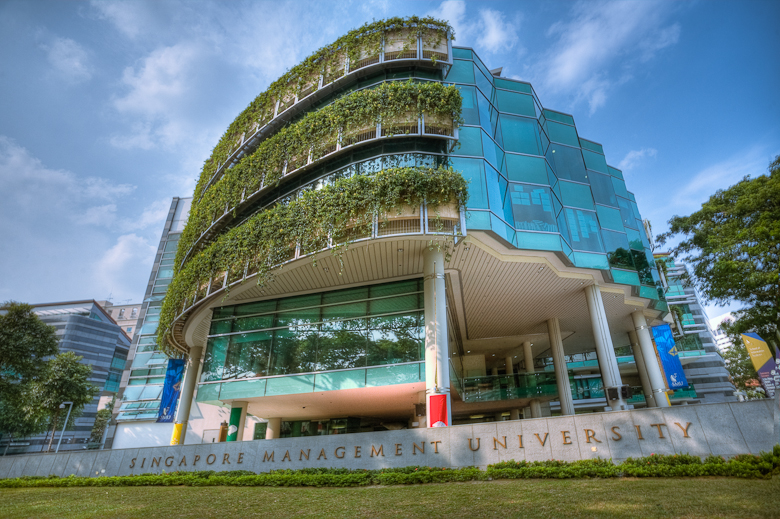
With the city at your doorstep, there will never be a dull moment experienced during your SMU stint. Boasting a state-of-the-art 4.5 hectare city campus with purpose-built seminar rooms to enhance your learning experience and stimulate class interaction, you will be immersed into an interactive and interconnected environment that will help you to grow beyond the classroom context.
In addition to your convenient access to the gymnasium, swimming pool and the dance studio, enjoy amenities like food and beverage outlets, and banking and healthcare services within the vicinity.
As an integral part of Singapore's Central Business District, SMU is a stone's throw away from museums, theatres, art galleries, cafes and restaurants. Take a 5 to 10-minute bus or MRT ride to the shopping belt of Orchard Road, the cultural establishments of Chinatown and Little India, or the centre of nightlife, Clarke Quay.
SMU Yong Pung How School of Law’s Juris Doctor (JD) is a highly competitive and rigorous postgraduate programme that prepares candidates with a prior university degree for the practice of the law in Singapore. The JD, at its core, is deliberately taught in small, dedicated groups. You can expect your classmates to be drawn from diverse nationalities, cultures, and experiences. JD instructors are highly dedicated authorities in their own right, and bring with them a wealth of practical knowledge into the classroom. At SMU’s JD programme, we aim to cultivate leaders of the legal industry and beyond by invigorating the great potential of our students built on their experience and calibre. Besides a solid knowledge of law, our graduates will distinguish themselves in critical thinking, presentation, and making sound judgments.

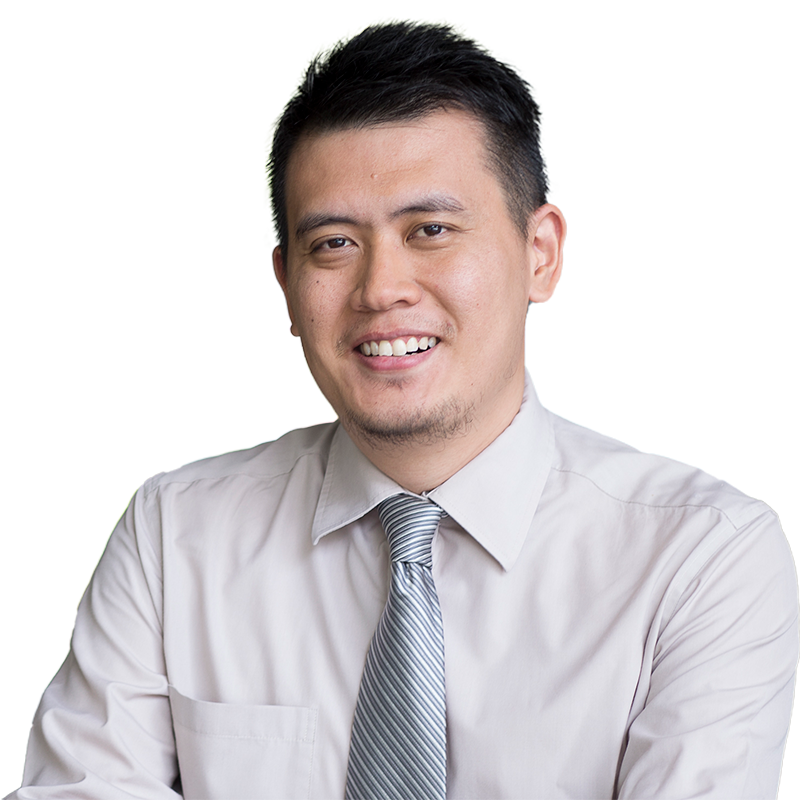
Associate Professor Zhang Wei
J.D. Programme Director
Yong Pung How School of Law


It's not a PhD or Masters
The J.D programme is a professional degree in law for graduates. An undergraduate degree (in any discipline) is required to be eligible for the programme.

It's a qualifying law degree
Graduates with a GPA of at least 3.0 are able to take the Singapore Bar examinations.

It's taught on an exclusive basis
All core law modules are taught in classes that only comprise fellow JD candidates and no LLB students.

Diverse student body
JD candidates hold a great variety of prior degrees and most bring with them considerable work experience, bringing vibrancy and different perspectives to classroom discussions.

Legal internship requirement
Candidates are required to do six-weeks of legal internship as part of graduation requirement; granting them exposure and a better understanding to the actual workings in a law firm.
Contact us
Ian R Taylor International Moots Programme At A Glance

170+
Top-3 finishes in international moots since 2010

380+
Prizes and best memos since 2010
60+
Top-3 finishes in Grand Slam moots since 2010
4
Best track record in Grand Slam Moots

3
Times being the only university to ever defend Grand Slam title

8
World records for most wins in a season in 2025
11
World records for most finals in a season in 2025

500
Alumni coaches and judges
The SMU Legal Innovation & Technology Club (SMU LIT) focuses on the convergence of technology and the law. SMU LIT aims to help SMU law students understand the importance of legal technology (LegalTech) and encourage its adoption. Our vision is to promote thought leadership in legal technology and produce technologically-equipped legal professionals ready to face the future of Law.