

The International Maritime Law Arbitration Moot, founded in 2000, is the leading moot in its field.
A J.D. student is required to complete a total of 25 course units of law courses (each course carries 1 unit unless stated otherwise). The list include:
- Commercial Conflict of Laws
- Comparative Legal Systems (0.5cu)
- Constitutional & Administrative Law (1.5cu)
- Contract Law 1
- Contract Law 2
- Criminal Law (1.25cu)
- Law of Business Organisations (1.5cu)
- Law of Equity & Trusts (1.5cu)
- Law of Evidence
- Law of Property (1.25cu)
- Law of Torts (1.5cu)
- Legal Research & Writing (1.5cu)
- Singapore Legal Systems (0.5cu)
- Legal Theory & Philosophy
- Capstone Project
- Commercial Conflict of Laws
- Comparative Legal Systems
- Constitutional & Administrative Law (1.5cu)
- Contract Law 1
- Contract Law 2
- Criminal Law (1.25cu)
- Law of Business Organisations (1.5cu)
- Law of Equity & Trusts (1.5cu)
- Law of Evidence
- Law of Property (1.25cu)
- Law of Torts (1.5cu)
- Legal Research & Writing (1.5cu)
- Singapore Legal Systems (0.5cu)
- Legal Theory & Philosophy
- Capstone Project
- Commercial Conflict of Laws
- Comparative Legal Systems
- Constitutional & Administrative Law (1.5cu)
- Contract Law 1
- Contract Law 2
- Corporate Law
- Criminal Law (1.5cu)
- Ethics & Social Responsibility for Law
- Law of Business Organisations
- Law of Equity & Trusts (1.5cu)
- Law of Evidence
- Law of Property (1.5cu)
- Law of Torts (1.5cu)
- Legal Research & Writing (1.5cu)
- Singapore Legal Systems (0.5cu)
- Legal Theory & Philosophy
- An Introduction to International Banking and Financial Regulation (0.5cus)
- Banking Law
- Corporate Insolvency Law
- Financial & Securities Regulation
- Law of Corporate Finance
- Law of Mergers & Acquisitions
- Legal and Commercial Principles in Project Financing Transactions
- Competition Law
- Comparative Law of Sales
- Domestic and International Sales
- Trade & Investment Law
- Foreign Direct Investment Law & Practice
- Joint Venture Law (Singapore – Indonesia)
- Shipping & Admiralty Law
- WTO : Law and Policy
- Appellate Practice in Civil Litigation (0.5cu)
- Contract Negotiation and Drafting
- Drafting of Commercial Agreements (0.5cu)
- Drafting of Corporate Practice (0.5cu)
- Introduction to Civil Procedure (0.5cu)
- Pre-trial Practice in Civil Litigation (0.5cu)
- Advocacy
- Complex International Litigation
- International Commercial Arbitration
- International Arbitration Practice
- Negotiation & Mediation for Lawyers
- Corporate Crime
- Construction Law
- International Construction Law
- Law of Cybercrime and Digital Investigations
- Principles of Singapore Income Tax
- Principles of Taxation of International Business Transactions
- Insurance Law
- Economic Analysis of Law
- International and Comparative Criminal Justice
- International Law and Global Politics
- Jurisprudence: Modern & Critical Theories of Law
- Law & Regulation
- Law and Policy of Ethnic Relations in Singapore
- Public International Law
- Information Technology & the Law
- Intellectual Assets and the Law in Asian Economies
- Intellectual Property Law
- International Commercialisation of Intellectual Property
- International Patent Law and Policy
- Law of Confidential Information, Trade Secrets and Privacy
- Directed Research
- Family Law
- International Moots
- Law Study Mission
- Law and the Changing Media Environment

For someone who admits to having stumbled into a law career by following in his brother’s footsteps of enrolling into law school, Professor Tang Hang Wu has certainly come a long way.
The SMU Yong Pung How School of Law professor once toyed with the idea of saving lives as a doctor when he was in school, but soon discovered that he was “hopeless at biology and dissecting rats”. Instead, he decided to switch paths and dedicate his life to research and teaching as a legal academic. After spending several years as a junior lawyer for Justice Quentin Loh before his elevation, Prof Tang found his calling in academia — and has since been a leading law professor for over two decades.
“I realised that I enjoyed researching and reading up on the law and hence I thought being an academic would be an ideal job for me,” recalls Prof Tang.
“The time in practice has been tremendously helpful – it taught me humility and the difficulties in convincing a judge of what you say is right.”
Today, besides teaching courses such as Property Law, Principles of the Law of Restitution and Equity and Trusts, the author of law tomes still keeps a foot in practice by accepting occasional briefs from law firms in his areas of expertise as “it keeps me up to date about the legal issues that people are facing in practice”, he explains. For example, Prof Tang is a consultant with TSMP Law Corporation and a panel member of the Strata Titles Board which mediates and arbitrates disputes between condominium owners.
As a Professor of Law, he strives to equip students with the necessary technical legal skills that enable them to become confident lawyers of the future, and teaches students from the School’s Juris Doctor (JD) track, a full-time, three-year programme designed for bachelor's degree with experience in other industries who are looking to make a career switch to becoming a lawyer, or legal professionals from other jurisdictions.
A treasure trove of knowledge
Often described by peers as “a walking encyclopaedia of law”, largely due to his mental library of legal stories and ability to relay complex legal arguments through compelling narratives, Prof Tang’s JD seminars are peppered with anecdotes and learnings from his pool of industry knowledge.
“Because I advise law firms and occasionally appear in court to argue some cases, I have a sense of arguments which may or may not work in court,” shares Prof Tang.
“I remind my JD students that to run a successful case, you must have a ‘theory of the case’. In other words, you must be able to answer, ‘why should your client win this case?’ And the answer must be compelling and straightforward.”
A self-dubbed “legal realist”, Prof Tang believes that judges tend to work backwards and interpret the law to reach a solution that they feel is fair – which is why a compelling case theory is so important.
Another highlight of his practice are two cases where he successfully argued before the High Court and Court of Appeal to relook at the law on jointly-owned properties in the country. These cases have become key cases in property law. In arguing these cases, Prof Tang used historical material and case law from all over the world and illustrates the “use of comparative law and legal history in furthering a particular position in court”. By reading these cases, the students become aware that the material explored in the classroom has real world practical significance.
A comprehensive and in-depth legal education
The JD class comprises students who already have a couple of years of working experience under their belt, from backgrounds as varied as finance and manufacturing. Their core modules are taught separately from the undergraduate group so as to allow instructors to tailor their material to varying difficulties.
“The JD class is a close-knit group – very vocal, lively personalities and full of life,” remarks Prof Tang.
“The classroom atmosphere is often electric with valuable contributions flying from all corners of the seminar room in a fast and furious way. It’s always fun, challenging and exhilarating leading a JD class. I constantly feel they learn as much from one another as they learn from me.”
Whether at the undergraduate or postgraduate levels, students at SMU are fully equipped and trained to become lawyers in demand to solve pressing legal issues readily. All classes are taught in a highly interactive seminar-style format, which encourages active student participation and hones their ability to present cogent arguments well.
Furthermore, courses at SMU are also curated to meet the ever-evolving needs of society, to prep students sufficiently in being future-ready. At the Yong Pung How School of Law, for instance, Prof Tang shares that there is a keen awareness of how technology is likely to disrupt the legal industry, with various research centres focused on these disciplines, apart from industry seminars organised for students.
“Even in traditional courses like Property Law and Equity and Trusts, we grapple with issues in class such as ‘Are Cryptoassets Property?’ and ‘Is it possible to declare a trust over crypto assets?’. These are not esoteric questions but issues which lawyers in Singapore are being called to advise on today,” he adds.
Given the breakneck speed of digital transformation in recent times, Prof Tang recognises that the next generation of lawyers must retain a strong grasp of their foundational concepts and be able to advise clients adeptly in an increasingly digital world. A legal education should not only focus on preparing graduates for traditional practices, but also provide skills and opportunities in this new economy where they are needed most.
Considering the challenges that top law professionals will face, Prof Tang offers a piece of advice that Minister Indranee Rajah gave to his law school class when she was a recruitment partner at Drew & Napier: “don’t dwell on negative incidents”. In the early part of one’s career, it is common to be reprimanded by clients, senior partners and judges, says Prof Tang. But rather than replaying the mistakes in your brain and traumatising yourself again, he recommends for young legal professionals to learn from their mistakes and move on.
And instead of citing traits more traditionally associated with legal eagles such as assertiveness and the power of negotiation, Prof Tang expresses that mental well-being is an essential element for success in the profession.
“We need the support of loved ones, mentors and friends to survive in any career,” he reveals, and suggests for graduates to join The Law Society of Singapore, which offers opportunities to meet seniors and peers who understand what they are going through.
“I tell my former students and students who are about to graduate that they can’t be legal automatons and work all the time. The legal practice is a tough profession. Do not be too hard on yourself when things go wrong.”
REGISTER INTEREST IN SMU LLM PROGRAMME
You may register your interest in the SMU LLM programme to receive updates on programme information and upcoming admission events.
| DATES | EVENT | DETAILS |
|---|---|---|
| Upon Registration | SMU LLM Programme 1-On-1 Consultation Welcome to SMU LLM programme 1-On-1 Consultation. Register now and you will have 20 mins to chat with our recruitment manager. It will allow us to pre-access your eligibility and reply to your questions about programme and application. Time: TBC (Singapore Time Zone) Venue: Zoom meeting ( confirmation email with zoom link will be sent to registered email address once the registration is confirmed ) Notes:
| COMING SOON
|
The LLM is not a qualifying law degree in Singapore. Should you wish to qualify for the Singapore Bar, please apply for the 3-year full-time Juris Doctor Programme (JD) instead. A qualified foreign lawyer may become a Registered Foreign Lawyer, or take the Foreign Practitioner Examination administered by the Singapore Institute of Legal Education.
The LLM requires a basic law degree. However, those with substantive knowledge of the law may be considered on an individual basis. In the past, candidates with substantial experience in accounting firms and regulatory bodies such as the Monetary Authority of Singapore have been admitted into the programme.
No, you do not. If your postgraduate degree is from English-medium institutions in Australia, Canada, Hong Kong, Ireland, New Zealand, Philippines, United Kingdom and the United States, you do not need to take the English proficency test.
No, LLM classes are exclusive to postgraduate students.
As the content and approach in courses vary widely from institution to institution, the policy is not to grant exemptions or credit transfers.
Yes. Applicants can seek to audit selected courses in the programme. More details on auditing the LLM can be found here.
As a SMU full-time matriculated international student holding a valid student pass, you may take up employment in Singapore during the vacation and are exempted from applying for a work permit as stated in the Work Permit Exemptions Notification. However, during the term time, a student holding a valid student pass is only allowed to work part-time of less than 16 hours per week. A letter of consent is not required from the Immigration and Checkpoints Authority of Singapore or the university.
For more information, please refer to MOM- Employment of Foreign Students.
The school has purchased insurance coverage for all SMU students. Details on your medical coverage can be found here.
The living costs you incur will depend on your lifestyle. An international student may expect to incur the following per month:
| Accommodation | Meals | Transportation | Miscellaneous |
| S$500 - S$2,000 | S$300 - S$500 | S$100 - S$300 | S$500 - S$1,500 |
Yes, core LLM modules are accredited by the Singapore Institute of Legal Education and fulfil the mandatory Continuing Professional Development (CPD) requirements.
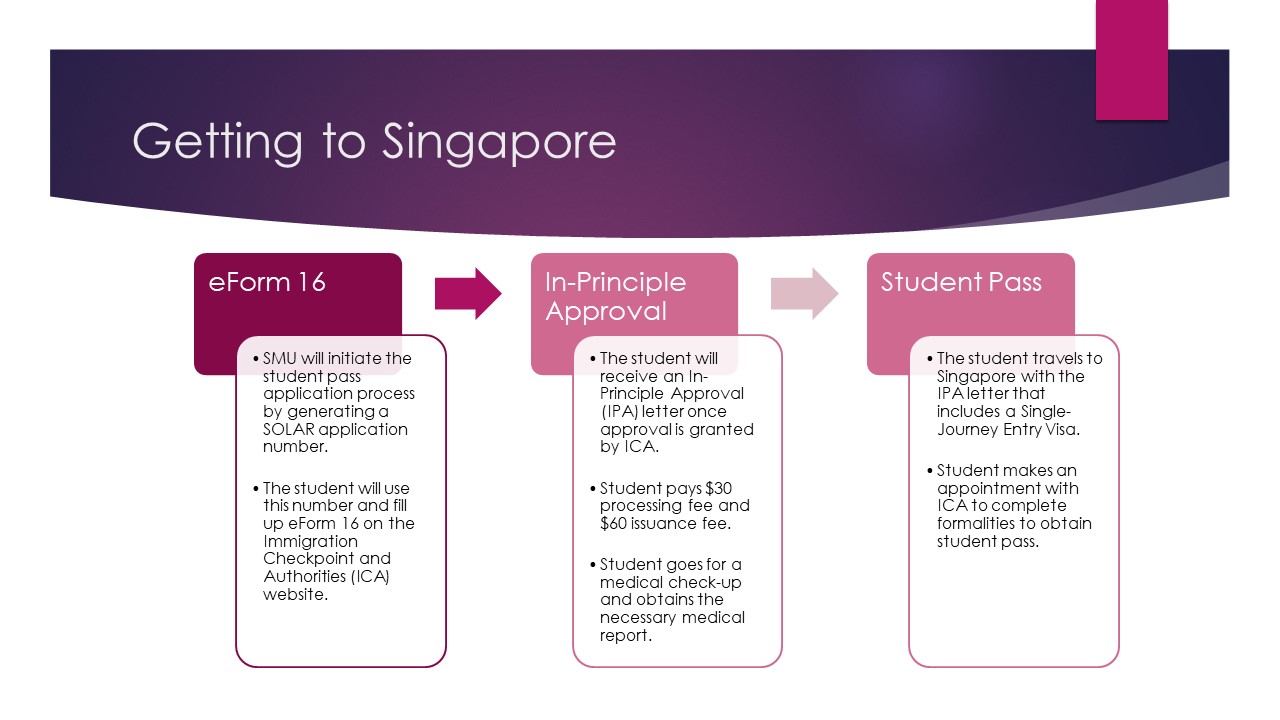
International students must possess a valid Student's Pass to be able to study at SMU. SMU will assist in the application of student passes once the offer to the programme is accepted. Under the Immigration Checkpoint and Authorities (ICA) regulations, only international students studying in a full-time programme are allowed to have student passes.
Application for Student's Pass is done online at the ICA website. You must receive a SOLAR application number from SMU before you can submit your application online. Your programme manager will usually initiate the application process in late May/early June. You will be provided with further details after the programme manager has registered you in SOLAR.
Student's Pass applications submitted electronically are generally processed in 5 working days for foreigners who do not require a visa to enter Singapore. For foreigners who require a visa to enter Singapore, the general processing time is 10 working days. Some applications may take a longer time to process.
For students who require visas to enter Singapore, the Student's Pass In-Principle Approval (IPA) letter will include a Single-Journey Entry Visa for your stay in Singapore till you have completed all formalities upon your arrival in Singapore. We will send the IPA letter via email once your Student's Pass application is approved. You can use the letter as a visa to enter Singapore. You are not required to apply for a separate visa.
If you wish to visit Singapore for personal reasons, please refer to the ICA website for a list of countries whose nationals require visas to enter Singapore.
Upon completion of the programme, students will have to give up their student passes. Extension of the student pass is not allowed once a student has completed graduation requirements.
Please note that the University does not sponsor the student's dependents (e.g. spouse, children, parents) for any immigration passes.
Private Apartments
You can engage the services of a property agent to help you find an apartment. There will be an agent's fee for this service.
Points to Consider When Choosing Accommodation:
- Rent - This includes the rental amount of the unit, rental deposit, security deposit, administrative charges, agent fees for service rendered, etc.
- Location - Do check whether the apartment/hostel is conveniently located and if public transport, grocery stores, food outlets or banks are easily accessible.
- Length of Lease - The lease of a unit is normally for at least a year. Landlords of private apartments usually ask for up to 3 months' rent as deposit. However, short term lease is available but usually at a higher rental.
- Others - The cost of accommodation depends on several factors such as the locality, type of premises, size, furnishings provided, recreational facilities available, length of lease. Housing in Singapore is generally expensive, especially within the city.
Do note that the contract / tenancy agreement will be made solely between the student and hostel management / owner. Please read the contract / tenancy agreement carefully before you make any commitment.
Singapore has one of the highest cost of living in South East Asia. Below are estimates of how much is required during your stay in Singapore. They do not include tuition fees and travel expenses from your home country to Singapore.
An international student in Singapore spends, on average, about S$1,000 to S$3,000 a month on living expenses. This amount will, of course, vary depending on your lifestyle and course of study.
This table gives a rough estimate of basic monthly expenditure for an international student in Singapore:
| Item | Cost per Month (SGD) | Comments |
| Accommodation | $500 - $2000 | Rental varies with geographical area, type of accommodation, demand, facilities provided & the number of people sharing, etc |
| Utilities (including water and electricity) | $40 - $100 | |
| Food | $300 - $500 | Based on $10-$15 per day for 3 meals at a foodcourt. |
| Transportation | $100 | Depends on the distance and mode of transport. |
| Telecommunications | $50 | Varies with usage and promotional packages subscribed for telephone services, mobile services and internet access services. |
| Books & Stationery | From $100/term | Booklink at the SMU concourse stocks almost all the required textbooks. |
| Personal Expenses | $100 - $300 | Varies with the individual. Could include expenses on clothes, toiletries, entertainment, haircut, miscellaneous. |
| Medical Insurance | As a SMU student, you are automatically entitled to SMU Medical Insurance Coverage scheme that covers your basic medical treatment and consultation. |
For more information on living in Singapore, please click here.
Please click here for more details on SMU Medical Insurance Coverage Scheme.
The application for 2026 intake is open.
For New Applicant
You need to first register for an account with SMU before you can submit an online application form.
For Existing Applicant
If you have already created an account with SMU, please go directly to the Login page to continue with your application.
Important Dates (For 2026 intake)
Admission Process
ONLY FOR Judicial Studies / Cross-Border Business and Finance Law in Asia / Law and Technology Track.
For the Dual LLM in Commercial Law (Singapore & London) application, please check details here.
LLM applicants are admitted on a rolling basis. Once the class size is filled, applications for this cohort will close. All other applicants will then be considered for the following year's cohort.
An application is only considered complete when,
Online application and all required supporting documents are submitted before the application deadline.
Application fee is paid before the applicaiton deadline.
Failure to complete the above will render the application invalid.
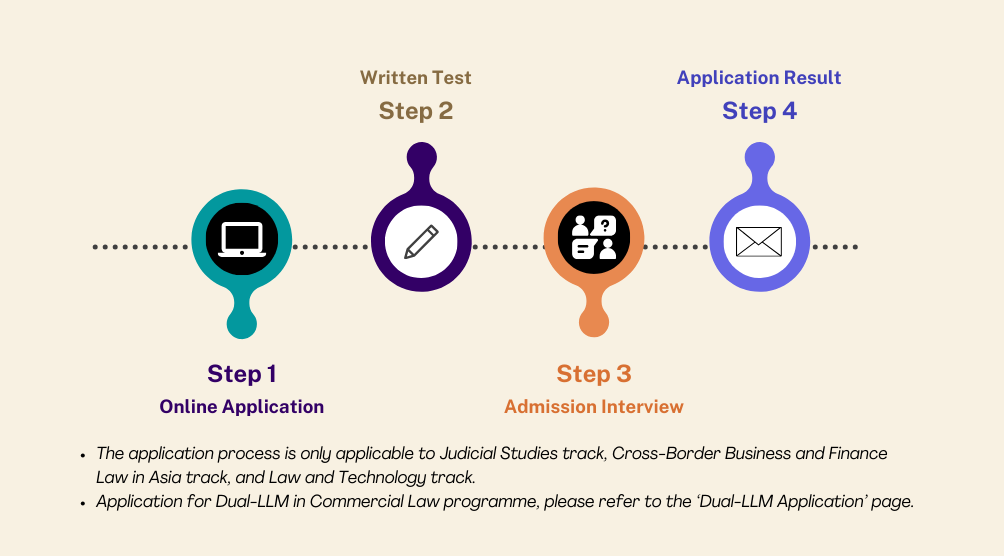
Step 1: Online Application
It is recommended that applicants access the online application system on a computer instead of a mobile device or tablet.
SMU LLM Online application step-by-step guide is available here.
Those completing their first degree by early July of the year of admission may also apply using their latest provisonal transcript. Students will be asked to submit their final transcript and graduate certificate letter/degree scroll later if they are offered a place in the programme.
An official translation would need to be uploaded for all documents which are not in English. Translation should be certified by the issuing institution or a Notary Public/Commissioner of Oath. Hard copies of required documents are not required during the application stage.
Shortlisted applicants will be required to take a LLM written test and participate in an interview online.
Any enquiries regarding the online application, please contact at smullm@smu.edu.sg. For IT issues, please contact SMU IT Help Centre at helpdesk@smu.edu.sg.
The following documents are required to accompany the online application:
Incomplete submission of documents will render the application to be dismissed from consideration.
Download LLM application document checklist here.
Identification document(s) 1) Singapore Citizen: A copy of NRIC. 2) Singapore Permanent Resident (PR): A copy of NRIC and re-entry permit. 3) Foreigner: A copy of passport personal particulars page. | Two Referees Two different referees are required. Please indicate the details of two referees in the online application form, including name, designation and email. The referee will receive a recommendation email from SMU once the LLM application is submitted. It may take around 15-20mins to complete the online recommendation form. Where possible, at least one of the recommendations should be from someone who has taught the applicant or supervised applicant's work in university studies. If applicant has left school for a long time and are unable to submit academic references, please provide 2 referees from people who are familiar with applicant's performance, such as employers/colleagues/clients etc. The contents of the recommendation are confidential. Under no circumstance should the applicant be able to see the contents of the recommendation. If referee couldn't receive SMU recommendation email, please ask referee to check spam folders or contact LLM programme office at smullm@smu.edu.sg directly. |
Degree Certificate The copy of the degree certificate(s) certified by the issuing institution or a Notary Public/Commissioner of Oath. And the bachelor's degree certificate is compulsory. Combine all degree certificates into one PDF file. | CV A concise resume that provides chronological information about your educational background, work experiences and accomplishments. Up to two (2) A4 pages. |
Transcript The copy of the official transcript certified by the issuing institution or a Notary Public/Commissioner of Oath. And the undergraduate transcript is compulsory. Combine all transcripts in one PDF file. | Statement of Purpose All applicants are required to submit a detailed personal statement based on the questions in the online application form. Maximum 600 words to each answer. |
IELTS/TOEFL English proficiency test results (TOEFL or IELTS) for all international applicants except those from English-medium institutions in Australia, Canada, Hong Kong, Ireland, New Zealand, Philippines, the United Kingdom and the United States. Scores that are more than 2 years old will not be accepted. For more details, please refer to the 'Admission Criteria'. GRE/GMAT, LSAT/LNAT or SMU Admission Test (SMUAT) is not required to the LLM application. | Application Fee Payment for the application fee must be made through the online application system. Applications submitted without payment will be considered incomplete and invalid. Please note that checks are no longer accepted by SMU. DO NOT pay the 'Optional Fee: 1st Attempt for SMU Admission Test (S$125)', which is not required to the LLM programme. All fees paid at the application and matriculation stages are non-refundable under any circumstances. |
Other Supporting Documents If any additional significant supporting documents, please send them to smullm@smu.edu.sg with the applicant’s full name and application reference number by the application deadline. Kindly combine all documents into a single PDF file, with a maximum length of six A4 pages. No additional supporting documents will be accepted after the application deadline. | |
Step 2: Written Test (Online)
- All applicants must take an LLM written test (1 hour) if shortlisted. The written test will be conducted via a Zoom meeting.
- Once required supporting documents are verified and completed online recommendations are well received, the LLM programme office will contact shortlisted applicants via email to register for the written test.
- Once the written test registration is confirmed, applicants will receive a confirmation email with a zoom link. Reminder emails are available near the test date.
- For the text invitation email, confirmation email and reminder emails, please kindly check both inbox and spam folders regularly.
- The written test is similar as a reading comprehension, applicants have to answer several short essay questions along side a long reading material in 1-hour. It aims to test the applicant's reasoning skills, legal knowledge is not required. No sample paper for reference. More details regarding the written test will be shared in the invitation email.
- There is no addional fees required to the LLM written test.
Step 3: Admission Interview (Online)
- Shortlisted candidates will be invited to an admission interview, which will be held individually (1 candidate to 1 faculty).
- The interview will be conducted via Zoom meeting.
- The LLM programme office will contact shortlisted candidates via email to register for the interview. Once the registration is confirmed, candidates will receive a confirmation email with a zoom link. Reminder emails are available near the interview date.
- Each interview session is around 15mins. No legal knowledge is compulsory.
- After the interview, LLM programme office will update application status via email within 2 weeks in general.
Fees
| Judicial Studies Track | Cross-Border Business and Finance Law in Asia Track | Law and Technology Track | Dual LLM in Commercial Law (Singapore & London) Track | |
| Application fee (non-refundable) | S$100 inclusive of GST | Applicants shortlisted by QMUL will be required to pay to SMU an application fee of S$100 inclusive of GST. | ||
| Registration fee (non-refundable) | Singaporeans / SPR: S$400 inclusive of GST Foreigner: S$500 inclusive of GST *Amount payable upon acceptance to the programme. The registration fee includes matriculation, examination fees, orientation activities, library & computer account. | |||
| Tuition fee | For 2026 Intake S$38,150 Inclusive of GST (9%) Non-refundable Deposit before matriculation: S$5,000 Inclusive of GST *All LLM students, whether enrolled full-time or part-time, are required to pay the tuition fees in two instalments during the first year of the LLM programme. | For 2026 Intake The tuition fees are:
| ||
* It's recommended to make payment by Visa or Master Card in the application system or student portal, the cheque is no longer accepted at SMU.
Financial Assistance
The Singapore Management University (SMU) reserves the right to amend the discount schemes for new incoming cohorts when required.
Please note that discounts will not be awarded in conjunction with other ongoing discount schemes, discount and scholarship are not stackable. Should a student qualify for more than one discount, only the higher discount amount will be applicable. All exemption decisions by SMU are final and not subject to appeals.
Tenure & Benefits of the Scholarship
- Up to four (4) bond-free scholarships per academic year.
- Each scholarship has an annual value of S$10,000.
- Scholarship of $10,000 is disbursed in 2 equal installments of $5,000 to offset tuition fees in Term 1 and Term 2.
- Demonstrate good conduct and compliance with the University’s prevailing code of conduct and other rules and regulations applicable to the scholar.
- Application via an application form is required once applicants accept the offer. Assessment will based on written test and interview scores, and relevant supporting documents. The application form will be sent to all candidates after the application deadline. Completed application forms and supporting documents are to be sent to the Programme Manager.
Eligibility
- Open to all LLM applicants (full-time and part-time) who are offered a place in the programme.
- Must not be a recipient of other scholarship or sponsorship.
- Scholarship offered is only valid in the year of offer, and cannot be carried forward.
The SMU PG ASEAN Scholarship, funded by SMU Office of Postgraduate Professional Programmes (PGPP), aims to develop top ASEAN legal talents. The scholarship co-funds outstanding individuals in his/her pursuit of the SMU LLM / Dual LLM programme.
Eligibility
- Applicants must matriculate into the SMU PG programme for which the scholarship has been awarded with. As the scholarship offered is only valid for this FY, matriculated students who defer their studies will not be able to carry forward their scholarships.
- The scholarship is open to citizens of ASEAN member and observer nations.
- At least "Very Good" admissions interview and essay scores
- Must not be a recipient of other scholarship or sponsorship
- Special consideration may be given to students with financial needs
Tenure & Benefits of the Local Postgraduate Scholarship Award
- The scholarship has a value of $10,000.
- The scholarship will offer financial support towards the Scholar's tuition fees, living allowances and the purchase of textbooks.
- No bond is required under the terms of this Scholarship
- No application is required for the PGPP Scholarship, ASEAN candidates who meet the criteria will automatically be considered.
No application required. All eligible students will be considered for this scholarship.
SkillsFuture funding for Singapore Citizens, click here for more details.
Singapore Citizens aged 40 years and above can claim SkillsFuture Credit (Base Tier) and $4,000 SkillsFuture Credit (Mid-career Tier). This credit is intended to offset out-of-pocket tuition fees, starting from Academic Year 2024/25 intake, commencing on or after 1 May 2024.
SkillsFuture Mid-Career Enhanced Subsidy (up to 90% of course fees) is not applied to the SMU LLM programme.
Singapore Citizens with eligible Post Secondary Education Account (PSEA) may utilize balance funds for tuition fees. More details can be found here.
Set up in 1991, the Lee Kuan Yew (LKY) Scholarship is the premier postgraduate scholarship in Singapore. It marks Singapore's continuous effort to recognise outstanding individuals with the aptitude and inclination to contribute to Singapore and our society.
Applicants, who must be Singapore citizens, will be assessed holistically. This includes their track record of leadership and achievement in their fields of pursuit/professions. Applicants should also have the potential to excel in their fields/professions, which will contribute to and benefit Singapore and our society.
Since its inception, many Lee Kuan Yew Scholarship holders have gone on to make significant contributions across varied fields including the Public Service, business, law, medicine, the arts and academia.
More details and application process can be found here.
The Jones Day Foundation has graciously decided to fund up to four Jones Day Master of Laws in Judicial Studies Scholarships for outstanding candidates enrolled in this programme at the SMU Yong Pung How School of Law, starting in AY 2020/2021. This scholarship demonstrates the Jones Day Foundation’s commitment to enhancing the rule of law by increasing the competency of judges and standing of judiciary in the region.
Eligibility
- Candidates must have been accepted into the LLM (Judicial Studies), either on a full-time or extended duration basis;
- Not be a Singapore citizen or Singapore Permanent Resident;
- Hold an LLB or JD from a reputable law school;
- Demonstrate strong leadership aspirations and abilities;
- Strong professional references
Interested candidates can apply once they have received the offer to take up the LLM (Judicial Studies) degree at the SMU Yong Pung How School of Law. In support of their application, candidates must provide a personal statement of between 500 and 1000 words, alongside documentation that proves financial need, if applicable. In the personal statement, candidates may wish to highlight the anticipated impact of the degree on their current or future career, their reasons for their interest in the degree as well as any noteworthy personal or professional achievements to date. Short-listed candidates may be interviewed. The School will make a good faith effort to ensure that the available scholarships will benefit a diverse range of meritorious candidates, with reference to such factors as gender, cultural background, national origin, socio-economic background and financial need.
Tenure & Benefits of the Jones Day Master of Laws (Judicial Studies) Scholarship:
- Two (2) Jones Day (Judicial Studies) Scholarships for international candidates of $40,000 each;
- Throughout the duration of the scholarship, the scholar will be required to demonstrate good conduct and compliance with the University’s prevailing rules in this regard;
- This scholarship is bond-free
Notes and exclusions:
- Matriculated candidates who opt to defer their admission offer or studies will not be able to carry forward the scholarships
- Candidates cannot simultaneously hold any other scholarships
The best performing graduate of the LLM in Judicial Studies will receive the Jones Day Top Scholar Award. One such award will be awarded by the Yong Pung How School of Law per annum.
Each award has a monetary value of S$10,000.
The Top Scholar Award will be presented to the winner during the SMU Convocation Ceremony or another appropriate University event.
The Lee Foundation has graciously decided to make available up to six annual Lee Kong Chian Master of Laws (Judicial Studies) Scholarships for outstanding candidates enrolled in this programme at the SMU Yong Pung How School of Law. The scholarships are intended to off-set the tuition fees charged for the LLM (Judicial Studies) and cannot be used to defray living expenses. Up to six scholarships will be awarded each year: up to 4 Singapore citizens or permanent residents and up to 2 international candidates. Each scholarship is tenable for the full duration of the scholar’s studies, subject to continued observance of the eligibility criteria.
Eligibility
- Candidates must have been accepted into the LLM (Judicial Studies), either on a full-time or extended duration basis;
- Hold an LLB or JD from a reputable law school;
- Demonstrate strong leadership aspirations and abilities;
- Strong professional references;
- Special consideration may be given to candidates who demonstrate financial need, in particular those from non-OECD countries
Interested candidates can apply once they have received and accepted the offer to take up the LLM (Judicial Studies) degree at the SMU Yong Pung How School of Law. In support of their application, candidates must provide a personal statement of between 500 and 1000 words, alongside documentation that proves financial need, if applicable. In the personal statement, candidates may wish to highlight the anticipated impact of the degree on their current or future career, their reasons for their interest in the degree as well as any noteworthy personal or professional achievements to date. Short-listed candidates may be interviewed.
Tenure & Benefits of the Lee Kong Chian Master of Laws (Judicial Studies) Scholarship:
- Four (4) Lee Kong Chian Master of Laws (Judicial Studies) Scholarships for Singapore Citizens and Singapore Permanent Residents of $20,000 each;
- Two (2) Lee Kong Chian Master of Laws (Judicial Studies) Scholarships for international candidates of $40,000 each;
- Throughout the duration of the scholarship, the scholar will be required to demonstrate good conduct and compliance with the University’s prevailing rules in this regard;
- This scholarship is bond-free
Notes and exclusions:
- Matriculated candidates who opt to defer their admission offer or studies will not be able to carry forward the scholarships
- Candidates cannot simultaneously hold any other scholarships
Students who wish to apply for a bank loan may approach their local banks directly to enquire about and apply for available study loan packages. Please note that SMU does not have any formal collaborations with banks to provide loans for postgraduate students.
| Judicial Studies Track | Cross-Border Business and Finance Law in Asia Track | Law and Technology Track | Dual LLM in Commercial Law (Singapore & London) Track | |
|---|---|---|---|---|
| Entry Requirements | Good first degree in Law (LL.B. or J.D. or their equivalent). AND Significant relevant experience in legal or judicial positions is required. | Good first degree in Law (LL.B. or J.D. or their equivalent). OR Non-law graduates would be considered on the basis of substantial professional experience. | ||
| English Language Proficiency | Proof of English language proficiency (TOEFL or IELTS) is required for all international applicants except those from English-medium institutions in Australia, Canada, Hong Kong, Ireland, New Zealand, Philippines, United Kingdom and the United States. The minimum English proficiency test requirement is as follows:
From 21 January 2026, TOEFL introduces a new score scale from 1 to 6 in increments of 0.5. The minimum TOEFL score under the new scale as below.
| |||