

FEES
| Fee | Amount | Due Date |
| Advance tuition fee deposit | S$5,000 | Upon offer acceptance. |
| Registration Fee | S$ 500 - International Students S$ 400 - Singaporeans/Permanent Residents | Upon offer acceptance. |
The tuition fee for the entire programme will be $81,750 (Inclusive of GST*).
The fee is made payable four times over the first 2-year period. Students will have to make payment of their first billing of their tuition fee before the first term starts in mid-August. The remaining 3 billings will be paid before the course enrolment of each new academic term.
| Tuition Fee | Amount (inclusive of GST) | Due Date |
| 1st Billing (advance tuition fee deposit) Non-refundable | S$ 5,000 | As per due date on page 1 of this letter |
| 1st Billing (balance) | S$15,437.50 | Early August before term starts |
| 2nd Billing | S$20,437.50 | End October of Year 1 |
| 3rd Billing | S$20,437.50 | End June of Year 2 |
| 4th Billing | S$20,437.50 | End October of Year 2 |
| Total | S$81,750 |
Note:
- The tuition fees do not cover textbooks and course materials.
- Goods and Services Tax (GST) is a tax collected on behalf of the Singapore Government and will be charged at the prevailing rate.
- The first two instalments are extremely close to each other. Make your financial arrangements accordingly.
- There will not be any government subsidy for this programme. E.g . MOE Tuition Grant, Service Obligation Scheme. All applicants will have to be self-funded or to take a loan from the bank.
Fee Payment Modes
Payment should be made online via the student self service portal. The check is no longer accepted at SMU
Discounts & Student Financial Assistance Schemes
SMU ALUMNI DISCOUNT
With effect from the 2025 admission intake, SMU undergraduate and postgraduate alumni who are offered a place in the J.D. programme will automatically be granted a $8,000 discount on the J.D. tuition fee. The discount will be spread equally over the 4 payment instalment periods. SMU exchange and non-graduating students are not eligible for the alumni discount and SMU reserves the right to amend the discount schemes for new incoming cohorts when required.
SMU ALUMNI COURSE EXEMPTION DISCOUNT
With effect from 2025, a $3,000 discount above the $8,000 SMU alumni discount may be granted to the alumni if one (1) credit unit (CU) law module is approved for transfer, up to 4 CUs. The maximum discount amount for course exemption is $12,000 even if more than 4 CUs have been approved for transfer.
SUTD ALUMNI DISCOUNT (PPDP)
With effect from the 2019 admission intake, SUTD alumni who are offered a place in the J.D. programme will be granted a 10% discount under the Pre Experience Postgraduate Degree Experience Programme Agreement (PPDP). The 10% discount will be spread equally over the 4 payment instalment periods. The discount is only applicable to SUTD alumni when they apply within 5 years from the time they graduate from SUTD. SUTD exchange and non-graduating students are not eligible for the PPDP discount.
Please note that you can utilise the following to offset part of your tuition fees:
SkillsFutureCredit (SFC) – For students who are Singapore Citizens and Singapore Permanent Residents only. Please check your SFC course codes for your programmes before submitting the online application to utilise the fund; refer here for guidelines on the submission.
Bank Loans – Please approach these local banks directly to enquire and apply for the various study loan packages.
SMU PG Emergency Grant – This is a one-off limited emergency financial grant by SMU to assist postgraduate students facing unforeseen financial crisis and would require interim financial assistance while their families seek for long-term solutions to meet their financial needs.
Post-Secondary Education Account (PSEA) – For students who are Singaporean only. Please ensure that you have sufficient funds to use prior to the application and refer to the section under Payment Modes on the submission of the completed form. For enquiries on PSEA application process and approval, please contact the Office of Finance (select: Office of Finance Request > Financial Assistance > PSEA Ad-Hoc Application under Request Type).
Other relevant company sponsorships or subsidies that may be available to you.
Note: You are not eligible to use the CPF Education Scheme (CPF), the SMU Tuition Fee Loan (TFL) and Interbank GIRO for the deduction of tuition fees.
Scholarships
Please refer to the scholarship webpage here for the various scholarships and awards available to JD students.
Admission Milestones
*UPDATED 22 January 2026
| Item | Date | Event |
| 1 | June onwards | For full-time, international students who are granted full admission and have accepted the offer |
| Student Pass (visa) application starts | ||
| International students will require a Singapore SIM card with SMS access (not just data) | ||
| Please refer to ICA website for entry and health requirements: Travelling to Singapore - Overview (ica.gov.sg) | ||
| 2* | Round 1: | Online Matriculation & Online ID verification |
| Mid-June to Mid-July | (Detailed instructions will be emailed 2 weeks before) | |
| Round 2: | ||
| Mid-End July | ||
| 3* | Round 1: | Photo submission deadline for online matriculation |
| Early-Mid July | ||
| Round 2: | ||
| Mid-Late July | ||
| 4* | Mid-July | JD Scholarship deadline submission |
| 5* | Round 1: | Collection of SMU Student Card |
| Late July | Venue: SMU Administration Building, Level 4 Function Rooms 4.1 and 4.2 | |
| 9.30am - 12pm and 1.30pm - 5pm (TBA) | 81 Victoria Street, Singapore 188065 | |
| Round 2: | ||
| Late Aug | ||
| 11am - 1pm (TBA) | ||
| 6* | Late Jul and Early Aug (TBA) | Law Kickstarter Pre-Term Class: Common Law Reasoning |
| 7* | Late Jul and Early Aug (TBA) | Certified true copy (CTC) of undergraduate academic document submission. The CTC documents do NOT need to be legalised. Cost of CTC can be found here. Original transcipts sent directly from the university by post or digitally via OpenCert/Clearinghouse will also be accepted. |
| Compulsory orientation | ||
| Venue: Ngee Ann Kongsi Auditorium at the School of Accountancy, Classrooms at School of Accountancy and Lee Kong Chian School of Business. | ||
| 60 Stamford Road Singapore 178900 | ||
| (Detailed programme will be emailed ~ 2 weeks in advance) | ||
| 8* | Early Aug | Law Kickstarter: Pre-Term Classes |
| (Detailed instructions will be emailed ~ 2 weeks in advance) | ||
| 9* | Early Aug | Completion of Formalities (COF) for Student Visa |
| 10 | 17 Aug | Term Starts |
Academic Calendar
Please refer to the academic calendar here.
Details on timetable and course modules will be sent to you about a month before term starts.
SHAPING THE
FUTURE OF LAW
In this rapidly changing world, lawyers encounter complex problems that cut across multiple disciplines and borders. Beyond traditional litigation practice, lawyers offer a range of other services, from advising on complex cross-border transactions and mediating family disputes to structuring state power and wealth management planning. Therefore, it is important to understand the law against the broader business, social, economic, institutional and political contexts.
Against this backdrop, our law curriculum is carefully designed to provide a firm theoretical foundation while being multi- and interdisciplinary, flexible and practice oriented.
Our curriculum is constantly updated with input from the legal industry. The law modules are supplemented by the SMU Core Curriculum and relevant modules from the other schools. Beyond the basic curriculum, students can pursue our new LLB tracks or take a second degree or major from another school.
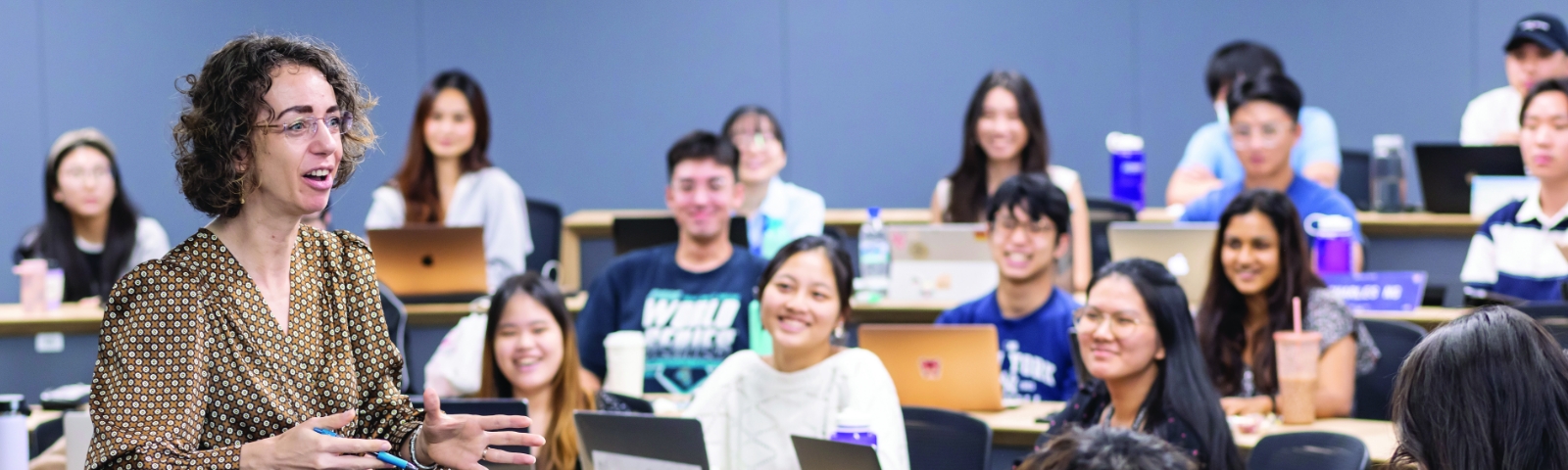
In small classes of up to 45, students gain confidence through vibrant seminar-style discussions, group presentations and written research assignments. Beyond traditional classroom activities, you will learn through hands-on work and closely supervised practical assignments in skills-based courses. Our signature SMU-X courses take experiential learning to the next level through supervised projects addressing real-world problems.
Further, you will see law in action through 10 weeks of law internship and 80 hours of community service, including 20 hours of pro bono. These are mandatory graduation requirements not only because of the obvious benefits of experiential learning but also because we want to instil the value of lawyering for good.
Bachelor of Laws (LL.B.) Curriculum
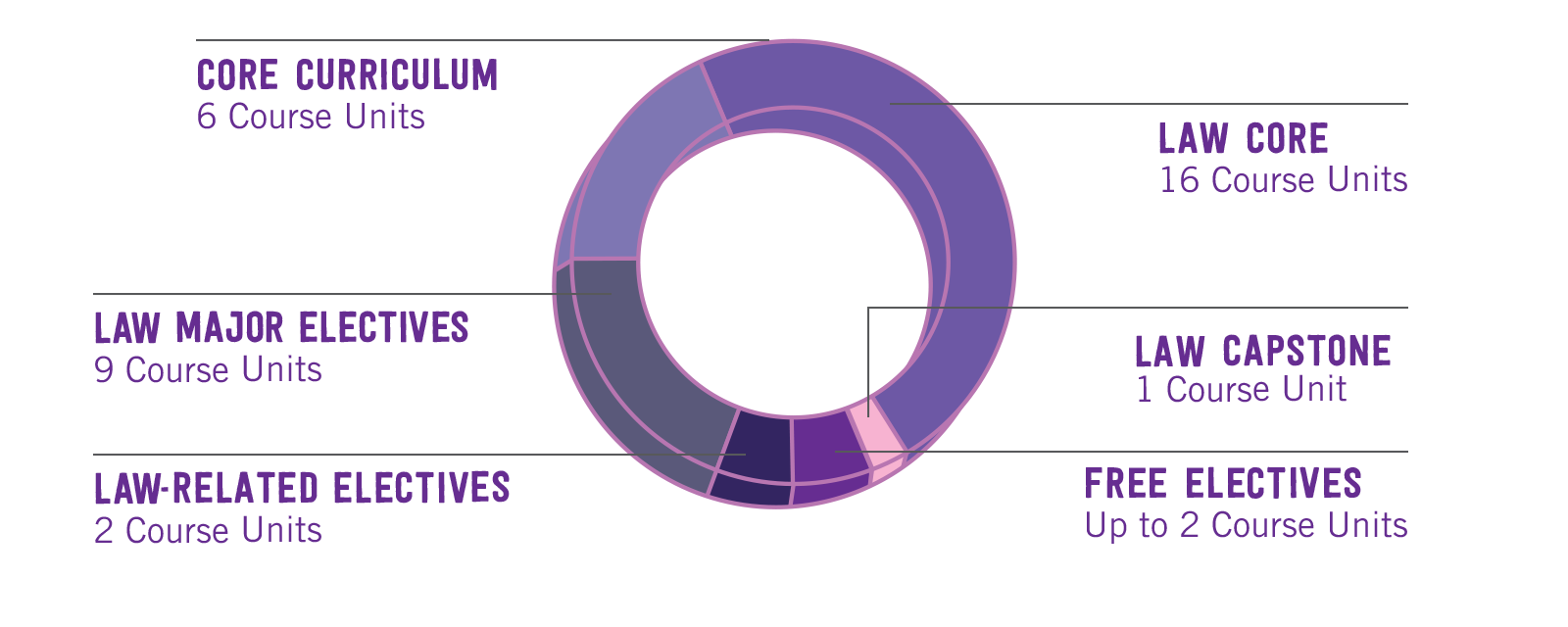
See detailed breakdown of the Bachelor of Laws (LLB) Curriculum
A typical Bachelor of Laws (LL.B.) Study Plan
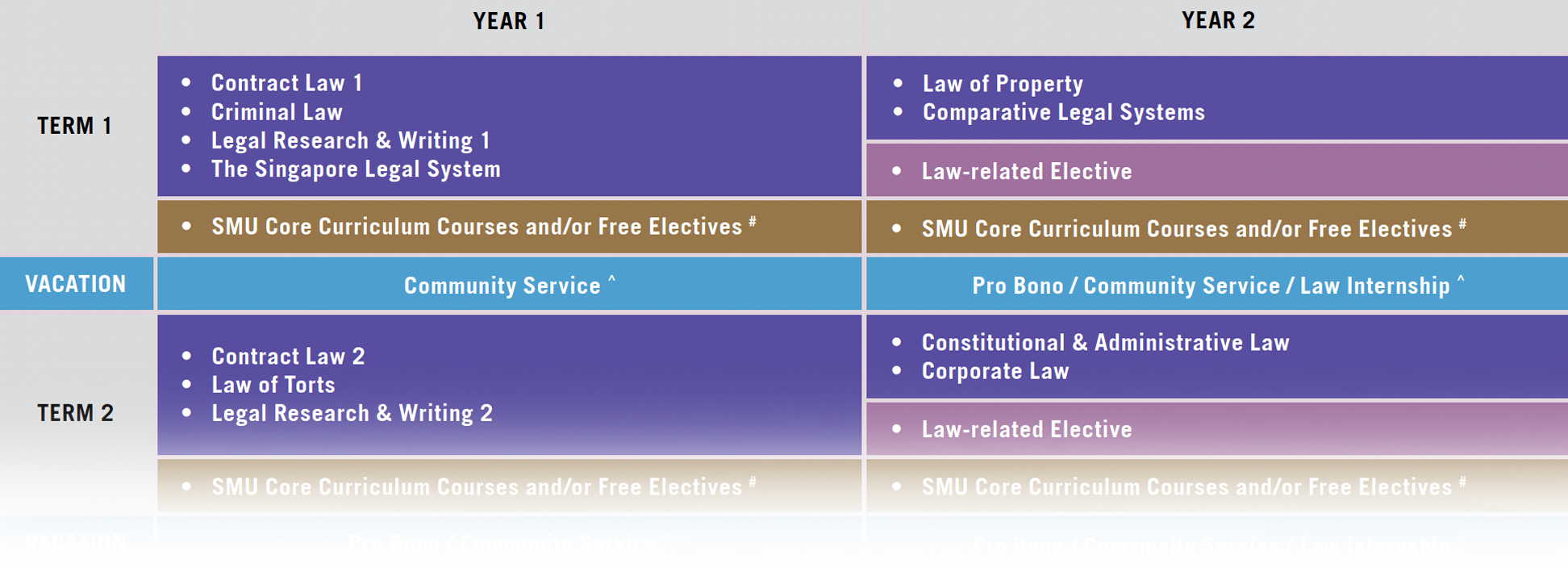
For the full study plan sample, please view the PDF.
LLB Tracks
There are a multitude of pathways to a career in law. Therefore, LLB students may pursue one of three specialisation tracks. Students declaring a track will benefit from greater disciplinary knowledge, industry awareness and practical skillset so as to be better prepared to pursue a career in their selected fields. Students are also free not to pursue a track, and instead customise their learning experience by choosing from our curated range of electives.
Building upon the firm foundation laid by the core law courses as well as the multi and interdisciplinary dimensions of the existing LLB curriculum, each track consists of 5 specifically curated electives from the following baskets.
CORPORATE TRANSACTIONS
Introduces students to the role of corporate transactional lawyers in the world of business, in facilitating mergers and acquisitions, business restructuring, project financing, joint ventures, and others.
- Comparative Corporate Governance
- Comparative Secured Transactions
- Compliance and Risk Management
- Corporate Insolvency Law
- Corporate & Securities Laws in China & the US: A Comparison
- Entrepreneurship in Singapore - From Cradle to Grave
- Financial & Securities Regulation
- International & Comparative Insolvency Law
- Law of Real Estate Securitisation (LLM)
- Legal & Commercial Principles in Project
- Finance for Law (LKCSB)
- Finance (LKCSB)
- Financial Accounting for Law (SOA)
- Financial Accounting (SOA)
- Corporate Deals (SMU-X)
- Law of Mergers & Acquisitions (SMU-X)
- The Law & Finance of Corporate
Transactions (SMU-X)
LAW AND TECHNOLOGY
Exposes students to the intersection between law and technology, in particular how laws respond to technological advancements and how technology can be harnessed to enhance the practice of law.
- AI, Law & Ethics (LLM)
- Blockchain & Governance (LLM)
- Computational Thinking & Legal Technology
- FinTech: Law & Policy
- Infocomm Technology & the Law
- Intellectual Assets & the Law in Asian Economies
- Intellectual Property Law
- International Commercialisation of
Intellectual Property - Introduction to Large Language Models, GPT & Legal Technology
- Law & Technology
- Legal Design
- Legal Innovation & Technology
- Privacy & Data Protection Law
- Digital Intelligence for Lawyers
- Business Data Management (SCIS)
- Introduction to Programming (SCIS)
- Digital Innovation for Access to Justice (SMU-X)
- Law & the Digital Commerce (SMU-X)
DISPUTE RESOLUTION
Provides a comparative overview of the various dispute resolution mechanisms—litigation, arbitration, mediation, and negotiation—so that the most suitable method (or a combination) is used to advance a client’s interest.
- Evidence, Litigation, & the
Criminal Process - Dealmaking & Dispute Resolution:
Negotiation in an Age of Disruption - International Moots 1
- International Moots 2
- International Commercial Arbitration
- International Mediation Law & Practice
- Introduction to Civil Procedure
- Negotiation in an Age of Disruption
- Pre-trial Practice in Civil Litigation
- Professional Mediation Skills
- The Singapore International Arbitration Centre (SIAC) & Institutional Arbitration
- Introduction to Psychology (SOSS)
- Law & Psychology
- Digital Innovation for Access to Justice (SMU-X)
- Dispute Resolution Advocacy (SMU-X)
- Law & the Digital Commerce (SMU-X)
Global Exposure
SMU students are guaranteed to broaden their horizons through at least one global experience, such as an international exchange, an overseas internship, a law study mission, or even an international competition.

LAW STUDY MISSION
Through Law Study Mission courses, students gain a deeper understanding of other countries’ legal systems, business environments, and cultures through organised tours to law firms, legal institutions, government agencies and businesses.
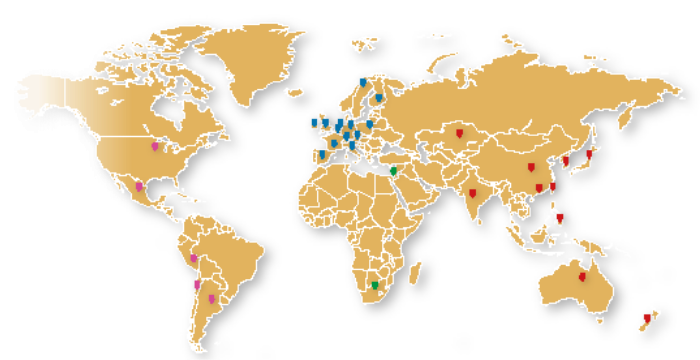
 The Americas: Argentina, Chile, Mexico, Peru and the United States of America
 Europe: Austria, Belgium, France, Germany, Ireland, Italy, the Netherlands, Poland, Spain, Sweden, Switzerland and the United Kingdom
 Middle East and Africa: Israel and South Africa
 Asia Pacific and Central Asia: Australia, China, Hong Kong, India, Japan, Kazakhstan, New Zealand, the Philippines, the Republic of Korea and Taiwan

80 and growing
Number of exchange partners

>55%
of law students who went on exchange
INTERNATIONAL STUDENT EXCHANGE
We are the first Asian law school to be part of the THEMIS network, which allows outstanding undergraduates from our school to go on exchange and undertake master’s level courses in selected partner institutions.
TEACHING EXPERTISE FROM AROUND THE WORLD
Besides virtual exchange programmes and international competitions, we have also pioneered, in collaboration with partner universities, courses taught jointly by instructors from both institutions. In such a course, students from both institutions learn together and interact in a virtual setting.
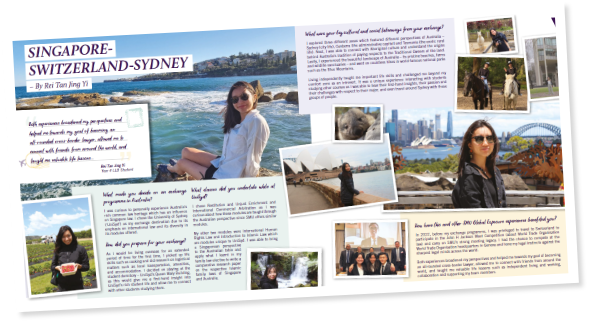
See what our LLB students have got to say about their experiences around the world.
Pro Bono
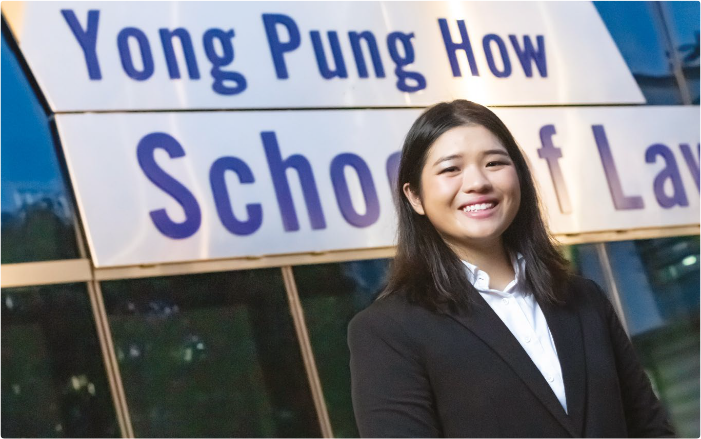
At the Yong Pung How School of Law, students perform legal community service pro bono publico (for the public good). Through our pro bono programme, students learn that the practice of law is a calling that brings with it opportunities to serve the community using their skills and knowledge. They appreciate the differences between theory and practice, and develop knowledge, skills, ethics, and professionalism to become lawyers better at serving both their clients and society more broadly.
Internships
Through internships, students learn about the practical workings of the legal system from a variety of perspectives. Students can intern at law firms and legal departments of corporations, banks, and so on, or with agencies such as ministries, the Attorney-General’s Chambers, or the State Courts – or any combination of these.

International Moots And
Alternative Dispute Resolution Competitions
Our students have unparalleled opportunities to participate in regional and international competitions, and have consistently produced world-class results. Under the Ian R Taylor International Moots Programme – which is also supported by leading firms WongPartnership and Providence Law Asia – around 100 students a year are able to participate in moot court (a simulation of court or arbitration proceedings) and alternative dispute resolution competitions.
In alternative dispute resolution competitions, our students have also done us proud. Notable results include winning CDRC Vienna (mediation), HSF-NLU Delhi (negotiation), APIIT (negotiation), ALSA (negotiation), SK Misra (negotiation), ODRC (mediation), Lex Infinitum (mediation), and NUJS (negotiation).

187
PODIUM FINISHES IN INTERNATIONAL MOOTS FROM 2010 to 2025
MOOTING HIGHLIGHTS
6 X INTERNATIONAL CRIMINAL COURT WORLD CHAMPIONS
JESSUP 2025 WORLD CHAMPIONS (4th WORLD CHAMPIONSHIP FINAL)
3 X VIS WORLD CHAMPIONSHIP FINALIST
3 X VIS EAST WORLD CHAMPIONS
3 X RANKED #1 WORLDWIDE
IN THE HEART OF ACTION
Beyond work, our location between Fort Canning Park, Orchard Road and the Central Business District provides our students ready access to plenty of good food, fun and opportunities for experiential learning.

A NEW CHAPTER
New students begin their exciting journey by participating in an orientation camp which is all about fun and making new friends. To help ease students in their transition to university life, all first-year students are assigned to members of the faculty, whom they may reach out to for academic advice. There is also a buddy system where first-year students are paired with second-year students. Throughout the term, students can expect to participate in a broad range of activities from formal talks to fun festive celebrations.


LAW CLUBS
SMU Law students may choose to join a number of student-run law clubs. The SMU Law Society, fondly known as The Bar, is the representative body for students and organises a variety of events. There are also nine sub-clubs, each of which provides the opportunity to pursue more specific areas of interest.
SMU Law Society ‘The Bar’ • Corporate & Commercial Law Club • SMU Sports & Recreation Club – SPARC • SMU Law International Relations Club • SMU Lexicon • Constitutional Law & Criminal Justice Club • Moot Court Club • Legal Innovation & Technology (LIT) Club • SMU Law Outreach Club • SMU Mediation & Negotiation Club • SMU Environmental & Sustainability Law Club (ESLC) • Student Chapter of the International LAw Association (SILA)

SMU’S Juris Doctor Law Degree
A legal education that rises to the challenges of the 21st century
What is the J.D. Programme?
The J.D. programme is a basic law degree for students who have undergraduate degrees in other disciplines and those who have studied law in civil law countries and in other jurisdictions.
Our Students
Drawn from various educational and professional backgrounds, our J.D. students include recent university graduates and those with several years of working experience.
Career Opportunities
Students will qualify for legal practice in Singapore (admitted as Advocate and Solicitor of the Supreme Court of Singapore) if they attain a J.D.
DISTINCTIVE FEATURES OF JD PROGRAMME

Exclusivity
JD students are in a class of their own for law core modules

Diversity
JD students come from different jurisdictions and varied disciplines with most of them having prior work experience

Experiential learning
Talks by legal practitioners, mooting experience

Internship
A 6-week internship at law firms, companies and the Singapore Legal Service

| High Level Learning Outcomes | YPHSL PhD in LCT Programme Learning Outcomes | |
|---|---|---|
i | DISCIPLINARY AND MULTIDISCIPLINARY KNOWLEDGE |
|
ii | INTELLECTUAL AND CREATIVE SKILLS
|
|
iii | INTERPERSONAL SKILLS
|
|
iv | GLOBAL CITIZENSHIP
|
|
v | PERSONAL MASTERY
|
|
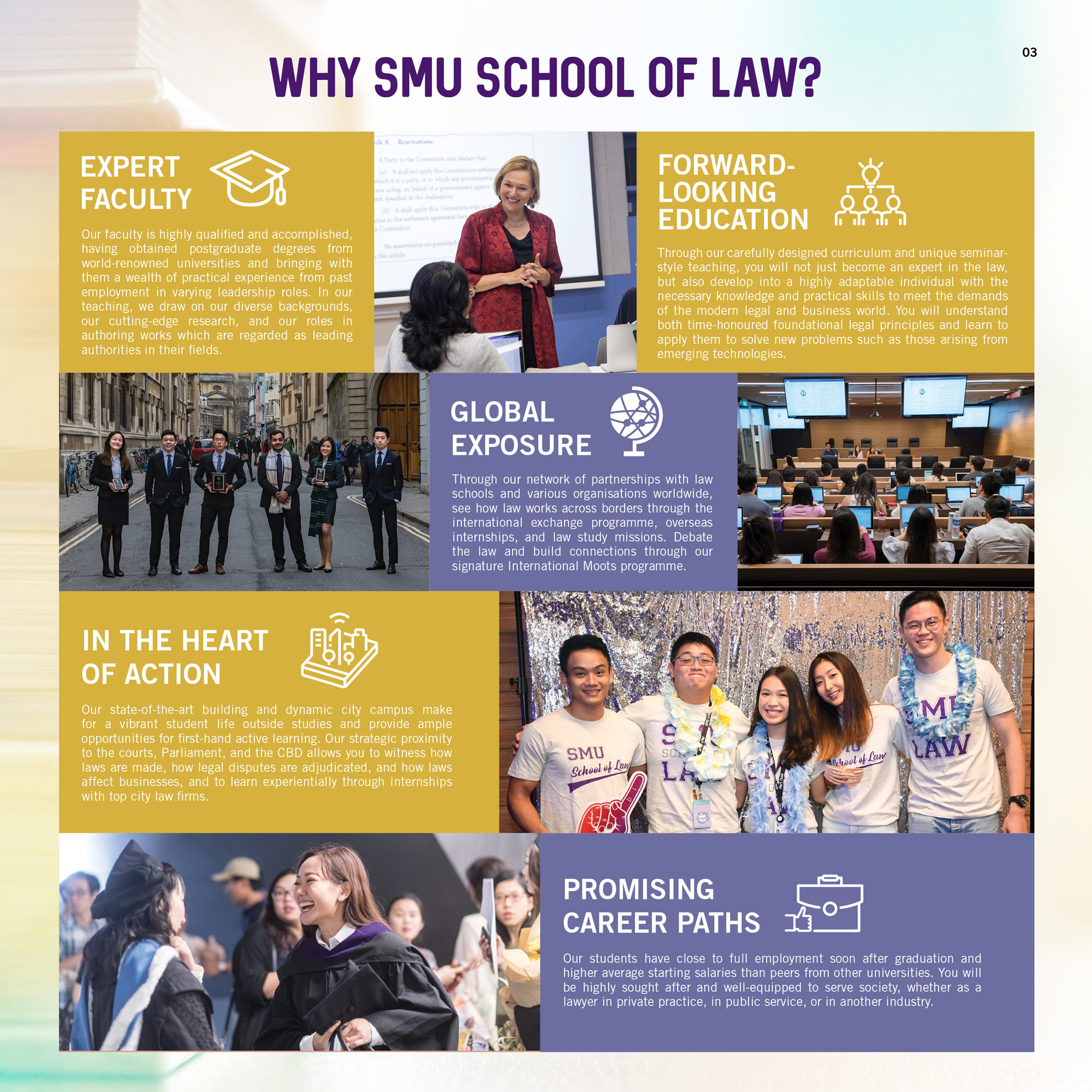
Strong Employment Outcomes
Our graduates are highly sought after, having close to full employment soon after graduation, with higher average starting salaries.
Diverse Career Options
Many of our graduates have gone on to make their mark in the profession, industry and academia. Despite having only six cohorts of working graduates, a number of our graduates have already struck out on their own to establish their own private practice and legal-tech start-ups. With an alumni network numbering more than a thousand and growing steadily, current students truly benefit from networking and job opportunities.
A Sample of Various Career Paths of SMU Bachelor of Laws Graduates
Academic
Corporate Lawyer
District Judge
Justices’ Law Clerk
Assistant/Deputy Registrar
Deputy Public Prosecutor
Entrepreneur
State Counsel
Civil Service Officer
Disputes Lawyer
In-house Counsel
Here are some of our alumni and the career paths they have taken after graduating from SMU:
"As legal counsel for Lazada, I help the company navigate ever-evolving and often ambiguous e-commerce laws across 6 different countries. Hard legal skills aside, the job requires a keen curiosity, the ability to adapt, and a flair for communication. SMU gave me these. My professors taught me to ask the right questions, to think beyond the box, and to express my views clearly. The modules I took also prepared me to apply the law in a business-minded and innovative way. I believe that the school equips its students well to flourish in this technological era.”

Olivia Wee
Lazada Group
Legal Counsel
"My 4 years at SMU Law were extremely enriching. An introvert by nature, SMU’s unique pedagogy of seminarstyle teaching in small class sizes gave me the chance to learn how to be more vocal and confident at expressing my views. Being graded on group assignments and presentations (besides the final-term exams) made me more adept in critical thinking, presentation skills and impressed upon me the importance of being a good team player. These skill-sets placed me in good stead when I entered private practice as a litigation lawyer. My experiences representing SMU Law in two international moots have also greatly impacted how I am now as a lawyer – the ability to think on my feet; to work well with one’s team; the importance of hard work and perseverance are all lessons I picked up as a mooter, all of which remain crucial in the practice of law."

Josephine Chee
Rajah & Tann Singapore LLP
Partner
"The practice of law is often said to be very different from the study of law, but SMU’s unique pedagogy ensures that its graduates are able to hit the ground running. From unique seminar-style learning that encourages critical thinking, to early and frequent interaction with legal practitioners and industry leaders, the SMU curriculum equips students with the necessary skill-set to thrive in whichever career path they choose. For me, the 4 years I spent in SMU were invaluable in preparing me to enter practice, and I credit SMU Law for giving me this head-start in my career."

Sui Yi Siong
Eversheds Harry Elias LLP
Senior Associate
"As the Joint Managing Director of WMH Law Corporation, Wilbur's clients consist of individuals and large corporations, including foreign listed company with annual turnover of approximately USD$1 billion. He is one of the few lawyers in Singapore to be selected as a finalist for the prestigious ALB's South East Asia Young Lawyer of the Year Award. Wilbur is also the youngest lawyer in Singapore to be honoured in the Asia's "40 under 40 lawyers" list published by ALB in 2017, which showcases the top 40 outstanding lawyers in Asia under the age of 40."

Wilbur Lim
WMH Law Corporation
Joint Managing Director